
A child who gets picked on usually does not need a speech about confidence. They need a way to feel stronger in their own body, steadier under pressure, and clearer about what to do when a hard moment starts. That is where martial arts for bullying prevention can make a real difference. Done well, training does more than teach self-defense. It helps kids carry themselves differently, respond with discipline instead of panic, and build the kind of self-respect that bullies often avoid.
Parents usually come in with a fair question: does martial arts actually prevent bullying, or does it just teach kids how to fight? The honest answer is that it depends on the program and the coaching. The best youth martial arts classes are not built around aggression. They are built around posture, awareness, boundaries, emotional control, and respect. Those qualities matter before any physical contact ever happens.
Why martial arts for bullying prevention works
Bullying often targets kids who seem isolated, unsure of themselves, or uncomfortable asserting boundaries. Martial arts training changes those signals over time. A child who trains consistently tends to stand taller, make better eye contact, and move with more purpose. That shift may sound small, but socially it can be powerful.
There is also a mental side that matters just as much. In class, students get used to challenge. They learn how to stay composed when something feels uncomfortable, how to listen under pressure, and how to recover after mistakes. Those are not just athletic skills. They are life skills, and they directly support bullying prevention because bullying thrives when a child feels helpless or overwhelmed.
At the same time, training gives kids language for boundaries. They practice listening, taking turns, and respecting space, but they also learn that they are allowed to protect themselves. That balance is important. A child should not be taught to become passive. They should be taught to be peaceful, alert, and prepared.
Confidence is not the same as aggression
One of the biggest misconceptions parents have is that self-defense training will make a child more likely to escalate conflict. In a quality academy, the opposite is usually true. Kids who feel capable often become less reactive because they no longer feel the need to prove anything.
Real confidence is calm. It shows up in the ability to say, “Stop,” with conviction. It shows up in walking away from bait. It shows up in knowing when to get an adult involved. Martial arts can help children develop that kind of presence because they spend time earning progress instead of pretending they already have it.
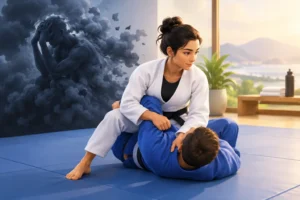
This is especially true in disciplines that emphasize control and technique over raw force. Brazilian Jiu-Jitsu, for example, teaches students how leverage and positioning work. A smaller child learns they are not powerless just because someone else is bigger or louder. That lesson can change the way they see themselves, and that shift often carries into school, sports, and friendships.
What kids actually learn in a good program
Parents often imagine anti-bullying training as one dramatic lesson about defending against a schoolyard shove. In reality, the most effective programs build protection through repetition and culture. Kids learn how to enter a room respectfully, how to follow instructions, how to handle frustration, and how to keep going when something is hard.
They also learn practical skills that support safer responses. That can include stance, balance, distance management, breakfalls, controlled grappling, and how to disengage from grabs or pressure. Just as important, they learn when not to use force. Good instructors repeat that physical skills are a last resort, not a first reaction.
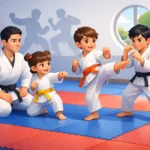
A strong class culture reinforces that message every day. Students bow or line up with focus. They partner with different teammates. They practice control, not domination. They are corrected when ego gets in the way. That environment teaches kids that strength and respect belong together.
The role of Brazilian Jiu-Jitsu in bullying prevention
Not every martial art addresses bullying in the same way. Striking arts can build coordination, fitness, and confidence, which absolutely helps. But for many parents, Brazilian Jiu-Jitsu stands out because it deals directly with close-range control. Since many bullying situations involve grabbing, pushing, pinning, or physical intimidation rather than a clean punch, grappling can be especially relevant.
BJJ teaches students how to stay calm in bad positions, protect themselves, and improve their situation without relying on size. That matters for children because school conflicts are rarely organized or predictable. A child may not have much room to move. They may be off balance. They may be scared. Training helps reduce that panic.
There is another advantage. Sparring in a supervised setting teaches problem-solving under pressure. Kids learn that discomfort is manageable and that technique beats panic. Over time, they stop freezing as quickly. They become more composed, and that composure is valuable whether they are dealing with a rude classmate, a tense social situation, or a real physical threat.
What parents should look for in a youth program
If your goal is bullying prevention, the right school matters as much as the right martial art. Some programs are too loose, and some are too harsh. Neither is ideal for a child who needs confidence, structure, and support.
Look closely at how instructors talk to students. Do they demand respect while still being encouraging? Do they correct behavior without humiliation? Do they make room for beginners who are shy, anxious, or behind athletically? Those details shape whether a child grows or shuts down.
It also helps to ask how the school handles anti-bullying conversations. A serious academy should be able to explain its approach clearly. Kids should be taught verbal boundaries, emotional control, and when to involve parents, teachers, or school staff. Physical technique matters, but it should sit inside a bigger framework of judgment and responsibility.
A multi-discipline environment can also be a strong fit, especially for families who want options as their child grows. Some kids connect immediately with grappling. Others gain confidence first through striking, pad work, or movement-based classes. The best training center is one that can meet a student where they are and help them develop from there.
Martial arts helps, but it is not magic
This part matters. Martial arts can be powerful, but it is not a guarantee that bullying disappears overnight. Some children need time before their confidence shows externally. Some bullying situations are social and relational rather than physical. In those cases, training is still useful, but it should be part of a wider support system that includes communication with parents, teachers, and school administrators.
It is also possible for a child to train at a good school and still struggle with fear. That does not mean the training is failing. Growth is not always loud. Sometimes progress looks like speaking up once instead of staying silent every time. Sometimes it looks like walking away without tears. Sometimes it looks like showing up to class again after a hard week.
Parents should keep expectations grounded. The goal is not to turn a child into an enforcer. The goal is to help them become more resilient, more aware, and more capable of protecting their space in healthy ways.
The community piece parents often underestimate
One of the best parts of martial arts for bullying prevention is not a single technique. It is belonging. Kids who train consistently become part of a team. They are surrounded by coaches and training partners who know their name, expect effort, and notice improvement. That support can be deeply stabilizing, especially for a child who feels overlooked or targeted elsewhere.
A strong academy becomes more than an activity. It becomes a place where discipline and encouragement live side by side. That combination matters because bullied kids do not just need comfort. They need standards, repetition, and wins they can feel. They need to earn confidence, not borrow it.
For families in Lakewood and the greater Denver area, that is why the training environment matters so much. A serious program with technical instruction, clear values, and a supportive culture can help children develop the tools to handle pressure with maturity. At Imperial BJJ Lakewood, that belief is central to how youth training should work.
Bullying prevention is not about teaching kids to look for fights. It is about helping them become the kind of people who can set boundaries, stay composed, and carry themselves with quiet strength. When a child learns that, the effects reach far beyond the mat.



1 Comment
[…] balance, and position through grappling. It is especially valuable for parents who want practical anti-bullying skills, because students learn to defend themselves, escape holds, and control a situation without […]