
Walking into your first martial arts class can feel like the hardest part. Most beginners are not worried about effort – they are worried about looking out of place, getting hurt, or falling behind. If you have been asking, is brazilian jiu jitsu good for beginners, the short answer is yes. For many people, it is one of the best places to start because it can be scaled to your fitness level, taught in a structured way, and built around technique instead of size or athletic background.
That said, beginner-friendly does not mean effortless. Brazilian Jiu Jitsu asks you to learn new movements, stay calm under pressure, and accept that progress comes one class at a time. For the right student, that challenge is exactly what makes it so rewarding.
Is Brazilian Jiu Jitsu Good for Beginners or Too Difficult?
BJJ has a reputation for being technical, and that part is true. There are positions, escapes, submissions, grips, timing, and strategy. From the outside, that can make it look like something you should only try once you are already in shape or already comfortable with contact sports.
In practice, good instruction changes everything. A well-run beginner class does not throw new students into advanced sparring and hope they figure it out. It starts with fundamentals. You learn how to move, how to protect yourself, how to maintain balance, and how to work from common positions. Each class builds on the last.
That structure is a big reason BJJ works for beginners. You do not need previous martial arts experience. You do not need to be flexible. You do not need to be naturally aggressive. You need patience, consistency, and a willingness to learn.
Why BJJ works so well for new students
One of the strongest advantages of Brazilian Jiu Jitsu is that it gives beginners a clear path forward. Many fitness programs leave people guessing about whether they are improving. In BJJ, progress has landmarks. First you learn how to shrimp, bridge, and frame. Then you learn how to escape bad positions. Then you start recognizing opportunities instead of just reacting.
That sense of measurable growth matters. Beginners often stick with training when they can feel themselves getting more capable, even in small ways.
BJJ also tends to attract people who did not see themselves as typical gym people. Some come in for self-defense. Others want better conditioning without the boredom of repetitive workouts. Some want confidence. Some want discipline. Many want a community that expects effort but still meets them where they are.
For adults and teens especially, BJJ can be a rare mix of mental and physical challenge. You are not just working hard. You are solving problems in real time.
What beginners usually struggle with
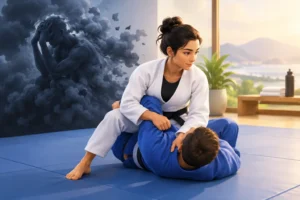
It helps to be honest here. Your first few weeks may feel awkward.
You may gas out faster than expected, even if you run or lift weights. Grappling uses pressure, positioning, and constant small adjustments that can tire out brand-new students quickly. You may also feel overwhelmed by the amount of information. That is normal. BJJ is a language, and at first everything sounds fast.
There is also the closeness of the sport. Unlike striking classes, grappling puts you in direct physical contact with training partners for long stretches. Some beginners adapt immediately. Others need a little time to get comfortable.
None of these are signs that BJJ is not for you. They are part of the early learning curve. A supportive academy and a strong fundamentals program make that curve much easier to manage.
Is Brazilian Jiu Jitsu good for beginners who are out of shape?
Yes, and this is one of the most common concerns people have before they start.
You do not need to get in shape before joining BJJ. Training itself helps build your conditioning, mobility, coordination, and body awareness. In fact, many people start precisely because they want a form of exercise that keeps them engaged enough to stay consistent.
The key is pacing. A smart beginner program lets you train at an appropriate intensity while you adapt. You do not need to win rounds or keep up with advanced students on day one. You need to learn good habits, train safely, and keep coming back.
This is where academy culture matters. In the right room, beginners are challenged without being crushed. Coaches explain the why behind the movements, and more experienced students understand how to work with new people respectfully.
The self-defense benefit beginners care about
A lot of people first consider BJJ because they want practical self-defense. That interest makes sense. Brazilian Jiu Jitsu teaches control, leverage, positional awareness, and how to stay composed in uncomfortable situations.
For beginners, that can be a major confidence builder. You start to understand how to protect yourself, how to create space, how to escape pressure, and how to think clearly when someone is resisting. Even early in training, those lessons carry over beyond the mat.
Still, it is worth keeping expectations realistic. BJJ is highly effective, but no single art covers everything. If someone wants a broader approach to self-defense, cross-training with striking or takedown-focused disciplines can add another layer of readiness. That is one reason many serious martial arts students value training environments that offer more than one discipline under one roof.
What your first class will probably look like
Most beginners imagine their first BJJ class as intense sparring with advanced students. A good academy does not start there.
Usually, your first class begins with a warm-up designed around movements used in grappling. Then the coach teaches one or two techniques, often tied to a basic position like guard, mount, side control, or back control. You drill those movements with a partner so you can learn the mechanics at a manageable pace.
Depending on the class format, you may also do positional training or light live rounds. If you are brand new, the goal is not to prove anything. It is to learn how class flows, how to move safely, and how to stay relaxed enough to absorb instruction.
Beginners are often surprised by how technical the experience is. The best sessions are not chaotic. They are structured, focused, and purposeful.
How to tell if a BJJ academy is actually beginner-friendly
Not every gym is equally good for first-time students. Some have excellent competitors but weak onboarding. Others talk about being welcoming but offer very little structure.
A beginner-friendly academy usually has clear fundamentals instruction, coaches who can teach without overcomplicating everything, and a culture where newer students are treated like future teammates instead of obstacles. Cleanliness matters. Safety standards matter. So does the ability to explain technique in a way that makes sense to normal people, not just experienced grapplers.
If you are in the Denver metro area, it makes sense to look for a school that combines technical credibility with a supportive atmosphere. That balance is what helps beginners last long enough to see real progress. At Imperial BJJ Lakewood, for example, the combination of structured instruction, strong community, and a serious BJJ lineage gives new students a place to start with confidence while still growing into high-level training over time.
Who benefits most from starting BJJ?
BJJ is especially strong for beginners who want more than just a workout. If you want structure, accountability, practical skill, and a real sense of progress, it has a lot to offer.
It is a strong fit for adults who are tired of traditional gyms, teens who need confidence and discipline, and parents looking for an activity that builds resilience in kids without relying on empty motivation. It can also be a great reset for people coming out of a stressful season of life. Training gives you something tangible to work on, and it rewards steady effort.
At the same time, BJJ may not be every beginner’s first choice. If someone strongly prefers striking, dislikes close-contact grappling, or wants only casual drop-in exercise with no learning curve, another program may feel more natural. There is no value in forcing the fit. The best martial art to start is the one you will train consistently.
If you are curious about BJJ, do not wait until you feel perfectly ready. Most people never do. Start where you are, ask questions, and give yourself permission to be new. A good first class will not ask you to be impressive. It will ask you to begin.




1 Comment
[…] Brazilian Jiu-Jitsu is a strong fit for adults who enjoy problem-solving. It teaches control, positional awareness, escapes, and submissions through technical drilling and live but supervised practice. Because leverage matters, smaller practitioners can develop effective answers against stronger partners. It is demanding, but intelligent training can be adjusted for beginners and different fitness levels. […]