
A lot of people start searching for the best martial arts for self defense after a moment that rattles them – walking to the car late at night, dealing with an aggressive stranger, or realizing that fitness alone is not the same as being able to protect yourself. That instinct is valid. But the honest answer is not as simple as naming one style and calling it done.
The best choice depends on what kind of self-defense ability you want to build, how you train, and whether your school prepares you for resistance instead of just repetition. A martial art is only as useful as the way it is taught. If your goal is real confidence under pressure, you need timing, control, awareness, and the ability to stay calm when another person is not cooperating.
What makes the best martial arts for self defense?
For self-defense, the most useful martial arts tend to share a few traits. They are pressure-tested against resisting partners. They teach distance, timing, and control. They also give students regular live practice, because a technique that works in theory can fall apart when someone is bigger, faster, or simply panicking.
That matters more than style loyalty. There is no single art that covers every situation perfectly. Striking arts help you manage distance and deliver force. Grappling arts help you stay standing, escape bad positions, or control someone without excessive damage. The strongest self-defense foundation usually comes from a combination of both.
Brazilian Jiu-Jitsu
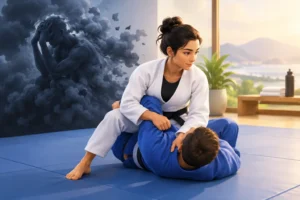
Brazilian Jiu-Jitsu is one of the strongest answers to the self-defense question because it teaches control against resistance from day one. You learn how to escape bad spots, break grips, manage someone trying to hold you down, and apply leverage instead of relying on size or raw strength.
That last point is why BJJ appeals to so many beginners, women, and smaller adults. It gives you practical tools for dealing with a larger attacker at close range. If a confrontation crashes into the clinch or goes to the ground, BJJ becomes highly relevant very quickly.
Its biggest strength is control. In real life, not every threat calls for knockout power. Sometimes you need to create space and get away. Sometimes you need to hold someone down until help arrives. Sometimes you need to neutralize a person without escalating further. BJJ gives you options.
The trade-off is that BJJ alone does not teach striking range the way a dedicated stand-up art does. A strong program should also address takedowns, grip fighting, and what to do before the fight hits the floor.
Muay Thai
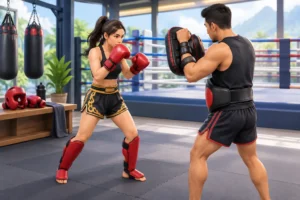
Muay Thai is one of the most effective striking systems for self-defense because it builds real composure under pressure. You learn how to strike with punches, kicks, knees, and elbows, but just as important, you learn how to manage distance, protect yourself, and stay balanced when chaos starts.
That has obvious value in a confrontation. If someone is advancing aggressively, grabbing, or crowding your space, Muay Thai teaches you how to stay structured instead of freezing. It also develops conditioning and resilience fast. People who train it regularly tend to carry themselves differently because they know what impact feels like and how to keep thinking through it.
The limitation is that striking arts do not always answer the grappling problem. If someone rushes in, clinches, or forces a takedown, striking alone may not be enough. That is why Muay Thai works best as part of a broader self-defense skill set rather than the only tool you have.
Wrestling
Wrestling is often underrated in self-defense conversations, but it should not be. A good wrestler understands base, balance, pressure, takedowns, and scrambles better than almost anyone. In plain terms, that means they are very hard to put down, very hard to control, and very capable of deciding where the fight takes place.
That control is a major advantage. In many real encounters, the person who wins the position wins the moment. Wrestling teaches relentless body awareness and the ability to stay effective against a resisting opponent who is trying to overpower you.
The trade-off is that wrestling, by itself, does not usually include submissions or striking defense in a complete way. It is excellent for control, but strongest when paired with BJJ or striking.
Judo
Judo deserves more credit than it gets in self-defense. Most people do not realize how powerful throwing skills are until they feel them. Judo teaches grip fighting, off-balancing, takedowns, and top control. In a close-range confrontation, those skills can end things fast.
It is especially useful because many real altercations begin with grabbing, pushing, or clinching. Judo lives in that range. A trained judoka can stay upright, disrupt posture, and put someone on the ground with authority.
Its limitation is similar to wrestling in one sense and opposite in another. It gives excellent stand-up grappling, but depending on the school, ground work may be less developed than in BJJ. Even so, for self-defense, the ability to stay standing and throw effectively is a serious asset.
Boxing
Boxing is simple, direct, and extremely effective at teaching defensive movement, timing, and clean punching mechanics. A good boxer learns how to keep composure while someone is trying to hit them. That alone separates trained people from untrained people.
For self-defense, boxing offers a fast path to practical stand-up competence. You learn footwork, head movement, distance management, and how to generate power efficiently. It is one of the best arts for developing confidence in the striking range.
The gap is obvious though. Boxing does not address kicks, clinch fighting, or ground situations in a complete way. It is valuable, but not complete on its own.
Krav Maga
Krav Maga is often marketed as the answer for self-defense because it focuses directly on dangerous scenarios. At its best, it can be useful for awareness, aggression, and scenario-based training. It may also address weapon threats and common street situations more directly than sport-based systems.
But quality control matters here more than almost anywhere else. Some schools offer realistic, pressure-based instruction. Others rely heavily on compliant drills that feel intense but do not hold up under resistance. If a Krav Maga program is not pressure-tested, its promises can outpace its results.
That does not make it bad. It just means you should evaluate the school carefully and look at how often students train against partners who are actively resisting.
So which style is best?
If you want the most honest answer, the best martial arts for self defense are usually Brazilian Jiu-Jitsu, Muay Thai, wrestling, and judo, with boxing also being highly effective. Not because they are trendy, but because they are trained live. Students learn to solve problems against resistance, and that changes everything.
If you can only pick one style, BJJ is one of the smartest places to begin for many adults because it gives a smaller person practical control skills, builds calm under pressure, and helps close one of the biggest gaps in untrained self-defense – what to do when a fight gets physical at close range.
If you can train two, pairing BJJ with Muay Thai is hard to beat. One teaches you what to do at striking range, the other teaches you what to do once things tie up or hit the ground. That combination creates a much more complete skill set than either style alone.
How to choose the right school
Style matters, but coaching matters more. A great school will teach fundamentals clearly, keep beginners safe, and give you a path from zero experience to real competence. It should feel disciplined, but not hostile. Serious, but not ego-driven.
Look for a place where students spar or roll with purpose, where technique is taught in detail, and where you can see a mix of beginners and advanced students improving together. That tells you the program is not built only for natural athletes or people who already know what they are doing.
If you are in the Denver metro area, training at a school that offers both grappling and striking under one roof can make a real difference. It gives you room to build a complete foundation instead of having to choose between them too early.
Self-defense is more than fighting
The strongest self-defense habit is awareness. The second is avoidance. The third is having the skill to act decisively if avoidance fails. Good martial arts training should support all three.
It should also build your character along with your technique. The right academy does not just teach people how to fight. It teaches composure, discipline, humility, and confidence you can actually feel in daily life. That is why the best training changes more than your reaction to danger. It changes how you carry yourself before danger ever shows up.
If you are trying to choose where to start, do not wait for a perfect answer. Start with a style that trains live, a coaching team you trust, and a community that pushes you while helping you grow. The best self-defense system is the one you will train consistently enough to make your skills real.


2 Comments
[…] self-defense, BJJ’s control-based approach can be especially valuable. Still, sport training and real-world […]
[…] self-defense is your main concern, look for instruction that addresses positional control, escapes, awareness, […]