
A lot of parents ask this when they watch their child bounce off the couch, wrestle with a sibling, or suddenly get shy in a new group setting: what age should kids start martial arts? The honest answer is not one perfect number. It depends on your child’s maturity, attention span, physical coordination, and the kind of program they’re stepping into.
That said, there is a useful rule of thumb. Many kids are ready to begin a well-structured martial arts program around ages 4 to 6. At that stage, they can usually follow simple directions, take turns, and participate in a class without needing constant one-on-one help. Younger children can still benefit from movement-based instruction, but the class has to be built for their age, not just scaled down from an older kids program.
What age should kids start martial arts in real life?
In real life, the best starting age is the age when a child can listen, participate safely, and enjoy the process. For some kids, that is 4. For others, it is 6 or 7. A highly active 3-year-old might have plenty of energy but not enough focus for a group class. A calm, coachable 5-year-old may do great right away.
This is why good martial arts schools do not just look at age. They also look at readiness. Can your child stay with a group for 30 to 45 minutes? Can they handle basic correction without melting down? Can they respect personal space and respond when an instructor gives a clear command? Those signs matter more than whether they just had a birthday.
Parents sometimes worry that starting “too late” will put their child behind. Usually, that fear is unnecessary. A 7-year-old who is ready to learn often progresses faster than a 4-year-old who is not. Early exposure can be great, but only if the environment matches the child.
The best starting age by stage
Ages 3 to 4
This can work, but only in the right program. At this age, martial arts should focus less on technical mastery and more on balance, body awareness, listening skills, and learning how to participate in a structured activity. Short attention spans are normal. So are uneven emotions.
A strong class for this age group feels organized, upbeat, and simple. Kids may learn stance, movement, basic coordination drills, and respectful habits like lining up and listening when the coach speaks. If the class expects perfect discipline or long stretches of stillness, it is probably not age-appropriate.
Ages 5 to 7
For many families, this is the sweet spot. Kids in this range often have enough focus to follow instruction and enough physical awareness to begin learning real fundamentals. They are also old enough to absorb the bigger lessons martial arts can offer, like self-control, resilience, and respect.
This is often when parents start seeing changes outside the gym. A child who struggles with confidence may begin speaking up more. A child with endless energy may start channeling it better. A child who gives up easily may learn that improvement comes from repetition, not instant success.
Ages 8 to 12
This is also an excellent time to start. Older kids can usually handle more detailed instruction and often progress quickly because they understand why drills matter. If a child has never trained before, this is not a problem. In fact, many beginners start here and thrive.
This age group can benefit a lot from martial arts because school and social pressure often become more complicated. Training gives them a place to work through challenge in a healthy way. They learn how to stay composed, how to solve problems under pressure, and how to earn confidence instead of pretending to have it.
Does the style matter?
Yes, a lot. When parents ask what age should kids start martial arts, they are often really asking two questions at once: when should my child start, and what should they start with?
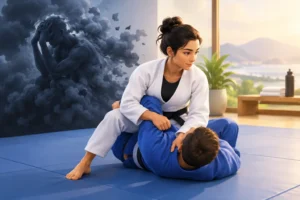
Different arts ask different things from a child. Brazilian Jiu-Jitsu can be excellent for kids because it teaches control, leverage, body awareness, and calm problem-solving without relying on size or aggression. Judo and wrestling can also be strong choices for athletic development and confidence. Striking arts like Muay Thai or kickboxing can be great too, especially in age-appropriate programs that emphasize discipline, technique, and control rather than hard contact.
The key is not choosing the “toughest” art. It is choosing the program with the right coaching, structure, and culture. A great youth class teaches kids how to train well, support teammates, and grow through challenge. A poor class, even in a good martial art, can turn a child off completely.
Signs your child is ready
Readiness is usually easier to spot than parents think. A child is often ready for martial arts if they can follow two- or three-step directions, stay engaged in a group setting, transition between activities without major disruption, and handle basic frustration without shutting down.
Interest helps too. Not every child walks in eager on day one, and that is normal. But there should be some level of curiosity or willingness. If a child is strongly resistant, forcing it usually backfires. Martial arts works best when a child feels challenged and supported, not pushed into a battle of wills.
It also helps if your child can separate play time from instruction time. Martial arts classes should be fun, especially for younger kids, but they should not feel chaotic. Learning to switch between movement and listening is part of the process.
Signs it may be better to wait
Waiting is not quitting. Sometimes it is the smartest move.
If your child cannot participate in a group safely, struggles heavily with transitions, or becomes overwhelmed by even short periods of structure, a few more months can make a huge difference. Development is not linear, and kids mature fast.
The wrong start can create a bad first experience. A child who feels lost or constantly corrected may decide martial arts “isn’t for them,” when the real issue was timing. Starting later in the right environment often leads to much better results than starting early in the wrong one.
What parents should look for in a kids program
The quality of the program matters as much as the age of the child. A strong youth martial arts class has clear expectations, coaches who know how to teach kids, and a curriculum built around development, not just activity.
Look for an academy that separates age groups appropriately and teaches with structure. Younger kids need simple instruction, repetition, and encouragement. Older kids can handle more detail and accountability. If everyone is lumped together without a clear plan, progress is harder.
Watch how the coaches interact with children. Good instructors are firm without being harsh. They keep classes moving, correct behavior calmly, and build confidence without lowering standards. That balance matters.
Culture matters too. Parents want a place where their child learns respect, not ego. A serious academy should still feel welcoming. Kids should be challenged, but they should also feel like they belong.
The benefits of starting at the right time
When kids start martial arts at the right age for them, the benefits stack up fast. They build coordination, discipline, confidence, and resilience. They learn how to lose without falling apart and how to improve without needing constant praise.
For some children, martial arts becomes the first place they really understand earned confidence. Not the loud kind. The steady kind. The kind that comes from showing up, practicing, and seeing themselves get better over time.
That lesson carries into school, friendships, and everyday life. It helps kids stand taller, communicate better, and handle pressure with more composure. Those outcomes do not come from age alone. They come from the combination of readiness, coaching, and consistency.
So, what age should kids start martial arts?
For most kids, ages 4 to 6 is a strong starting window. But the best answer is this: start when your child is ready for a structured class and when you have found a program built to teach children well.
If your child is younger and still developing those skills, waiting a little is fine. If your child is older and has never trained before, it is absolutely not too late. The goal is not to start as early as possible. The goal is to start well.
At a quality academy, martial arts gives kids more than exercise. It gives them standards, support, and a place to grow. If you are evaluating programs in Lakewood or the greater Denver area, look for coaches who take youth development seriously and know how to meet kids where they are. A good first experience can shape how a child sees challenge for years to come.
The right age is not just a number. It is the moment your child is ready to step on the mat, learn with purpose, and enjoy the work.




No comment yet, add your voice below!