
A good kids martial arts program is easy to spot once you know what to look for. Your child should leave class a little more focused, a little more confident, and a lot more willing to listen than when they walked in. For families searching for kids martial arts Lakewood CO options, that standard matters more than flashy marketing, crowded classes, or promises that sound too good to be true.
Parents usually start with a practical goal. Maybe your child needs more structure. Maybe they have energy to burn, struggle with confidence, or need better tools for handling conflict. Sometimes the goal is simple – you want an activity that teaches more than movement and gives your child a real sense of progress. Martial arts can do that, but only when the program is built the right way.
What parents should expect from kids martial arts in Lakewood CO
The best youth martial arts programs do more than keep kids busy after school. They create a clear system for growth. Children learn how to stand with confidence, follow instruction, work with partners, and handle small challenges without quitting the moment something feels hard.
That does not happen by accident. It comes from structured coaching, age-appropriate classes, and instructors who understand that teaching children is different from teaching adults. A strong academy has standards. Kids bow onto the mat or enter class with respect, pay attention when the coach is speaking, and learn that effort counts just as much as talent.
For parents, this usually shows up outside the academy first. You may notice better listening at home, more patience with frustration, or a child who carries themselves differently at school. Martial arts will not magically fix every behavior issue, and no serious coach should pretend otherwise. But in a quality program, the habits built in training often carry into daily life.
Why martial arts works for child development
Children respond well to environments that combine structure and encouragement. Martial arts gives them both. There are rules, routines, and expectations, but there is also visible progress. Kids can feel themselves improving. That matters.
When a child learns a takedown, a defensive movement, or a simple combination, they are not just collecting techniques. They are building body awareness, timing, discipline, and self-control. They also learn how to work through discomfort in a healthy way. Not every class feels easy. Not every skill clicks right away. That challenge is part of the value.
There is also a major difference between confidence and empty hype. Real confidence comes from doing hard things repeatedly. A child who has practiced escapes, drills, controlled partner work, and movement patterns under coaching starts to trust their own ability. That confidence tends to look calm, not loud.
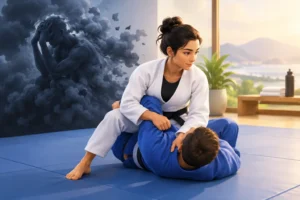
For many families, anti-bullying is part of the conversation too. Martial arts can help, especially when the academy teaches awareness, boundaries, posture, and de-escalation alongside physical skills. The goal is not to turn kids into aggressive fighters. It is to help them become harder targets, better communicators, and more composed under pressure.
The value of a multi-discipline youth program
Not every child connects with the same style of training. Some love the technical puzzle of grappling. Others respond to the rhythm and athleticism of striking. A multi-discipline academy can be a strong fit because it gives families more room to find what clicks.
Brazilian Jiu-Jitsu is especially valuable for kids because it teaches control, leverage, and problem-solving in a live but supervised setting. Children learn how to stay calm, improve position, and use technique over force. That can be a powerful lesson for smaller or less naturally assertive kids.
Striking-based training, when taught appropriately for youth, can improve coordination, balance, and focus. It also gives energetic kids a productive outlet. The trade-off is that youth classes need careful coaching and clear safety standards. Good instructors know how to keep training technical and controlled rather than chaotic.
A program that also draws from wrestling or judo can add another layer of athletic development. Takedowns, movement drills, and balance work build coordination in ways many traditional team sports do not. For some kids, that variety keeps them more engaged over time.
What to look for when comparing schools
If you are evaluating kids martial arts Lakewood CO programs, start with the coaching environment. Watch how instructors speak to children. Are they clear and firm without being harsh? Do they correct behavior with consistency? Do they know how to encourage shy beginners and challenge more confident kids without letting class get out of control?
The next thing to notice is class structure. Good youth classes move with purpose. There is a warm-up, skill instruction, supervised drilling, and a clean finish. Kids should not spend most of class standing around, and they should not be thrown into activities without guidance. Organized classes usually reflect organized coaching.
Curriculum matters too. A quality academy can explain what your child will be learning and why. You want a program that teaches foundational movement, discipline, and real skill progression rather than random techniques with no continuity.
Culture is another major factor, especially for families who want a long-term home and not just a short-term activity. The strongest academies feel serious without feeling cold. Kids are expected to work hard, but they are also welcomed, coached, and included. That balance is what helps children stick with training long enough to benefit from it.
Why instruction quality makes a difference
In martial arts, lineage and curriculum are not just buzzwords. They shape what gets taught on the mat every day. When an academy is connected to proven, high-level instruction, students benefit from a system that has been tested and refined.
That matters for adults, and it matters for kids too. Children deserve more than improvised classes. They need coaches who teach with intention and understand how to build skill step by step. In a strong program, beginner students are not lost, advanced students are not neglected, and every class has a purpose.
This is one reason families often choose an academy with real technical credibility behind it. Serious instruction creates better habits early. It also gives parents confidence that the program is grounded in more than personality alone.
At Imperial BJJ Lakewood, that standard is reinforced by a world-class Brazilian Jiu-Jitsu affiliation and a coaching approach built around structure, progression, and community. For families, that means children can train in an environment that is welcoming from day one while still being rooted in legitimate martial arts instruction.
Is martial arts right for every child?
Usually, yes – but not always in the same way or on the same timeline. Some kids thrive immediately. Others need a few weeks to settle in, especially if they are shy, highly energetic, or unsure about trying something new.
That is why patience matters. A child who looks hesitant in their first class may become one of the most consistent students in a few months. On the other hand, if a program expects every child to adapt instantly without support, that is usually a sign the coaching is too rigid.
It also helps to be honest about your goals. If you want elite competition training, your criteria may be different from a parent who wants confidence, focus, and healthy activity after school. Neither goal is wrong. The key is finding a program that matches what your family actually needs.
A better standard for youth training
Parents in Lakewood and the surrounding Denver area have options, which is a good thing. But more choices also mean more noise. The strongest decision usually comes down to this: choose a school where your child is taught with respect, challenged with purpose, and developed through real martial arts rather than entertainment dressed up as discipline.
When that fit is right, kids do not just learn techniques. They learn how to show up, pay attention, handle setbacks, and keep improving. Those lessons stay with them long after class ends, and that is what makes the right program worth finding.



3 Comments
[…] Parents should also look at whether the academy sees martial arts as character development or just activity programming. There is a difference. The best schools help young students become more resilient in school, more respectful at home, and more confident in social situations. […]
[…] many families, anti-bullying is another major reason to enroll. This is where nuance matters. Good BJJ training is not about […]
[…] teens and kids, this can be even more important. Good martial arts training does not encourage reckless behavior. […]