
Saturday mornings tell the truth. If one child is melting down, another has soccer across town, and the adults are trying to piece together fitness, structure, and family time from whatever is left, the wrong activity makes life harder. The best martial arts classes for families do the opposite. They simplify the week, give everyone a clear path to progress, and create a shared routine that actually strengthens the household.
For many parents, the search starts with one question and quickly turns into five. Will my child feel comfortable? Can beginners keep up? Is this about discipline, self-defense, fitness, competition, or all of the above? And just as important, will the environment feel serious without feeling cold? Those answers matter more than the style name on the schedule.
What makes the best martial arts classes for families?
Family-friendly martial arts are not just children and adults training in the same building. A strong family program is structured so each age group gets what it needs without watering down instruction. Young children need focus, movement, and clear boundaries. Teens need challenge, accountability, and coaching that earns respect. Adults usually want a mix of fitness, practical skill, stress relief, and a healthy training culture.
That is why coaching quality matters more than flashy promises. A great family academy has instructors who can teach fundamentals with patience, maintain high standards, and create real progress over time. The room should feel organized. Classes should start and end with purpose. Beginners should know what to do, and experienced students should still feel challenged.
Safety is another non-negotiable. In family martial arts, safe training does not mean soft training. It means controlled instruction, age-appropriate drills, clear supervision, and a culture where respect is expected. Families stay consistent when they trust the process.
The best styles depend on your family goals
There is no single answer for every household because different martial arts solve different problems. The best fit depends on whether your family is looking for confidence, self-defense, competition, athletic development, or a better way to stay active together.
Brazilian Jiu-Jitsu for confidence and practical control
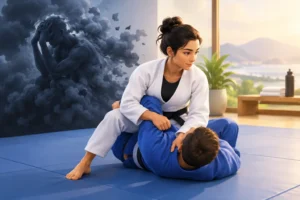
Brazilian Jiu-Jitsu is often one of the strongest choices for families because it gives both kids and adults a practical system built around leverage, control, and problem-solving. For children, BJJ can be especially valuable because it teaches them how to stay calm under pressure, use technique instead of panic, and build confidence without relying on aggression.
Parents tend to appreciate that BJJ develops discipline in a very real way. Progress is earned, not handed out. Students learn patience, attention to detail, and how to handle difficult positions without quitting. For adults, it offers a serious workout and a highly technical martial art. For kids, it supports anti-bullying skills, body awareness, and resilience.
If a family wants one discipline that can grow with them for years, BJJ is a strong contender.
Muay Thai and kickboxing for fitness and striking skills
Some families want a more fast-paced, striking-based program. Muay Thai and fitness kickboxing can be a great fit, especially for adults and teens who enjoy high energy classes and visible conditioning progress. These styles improve cardio, coordination, balance, and confidence quickly.
For younger children, it depends on how the academy structures the program. A well-run youth striking class teaches control, footwork, discipline, and technique. A poorly run one can become chaotic. That is why instructor oversight matters so much in this category.
For parents who want to train while their child builds confidence in a separate class, striking programs can make a lot of sense. They are engaging, demanding, and often easier to start than people expect.
Judo and wrestling for athletic development
Judo and wrestling are excellent for families who value toughness, balance, coordination, and strong fundamentals in grappling. These arts teach movement, pressure, timing, and physical awareness in a way that carries over into other sports.
For kids, that can mean better agility and confidence in physical situations. For teens and adults, it means learning how to control scrambles, takedowns, and transitions with real precision. The trade-off is that these styles can be physically demanding early on, so beginners benefit most when the coaching is highly structured.
Multi-discipline programs for families with different needs
In many homes, one person wants self-defense, another wants fitness, and a child simply needs confidence and structure. That is where a multi-discipline academy stands out. Instead of forcing everyone into one lane, it gives each family member room to pursue the right path while staying in one community.
This setup also solves a practical problem. Busy families are more likely to stay consistent when classes are in one place, with one schedule, and one coaching culture. That convenience is not a small detail. Consistency is where the real benefits show up.
How to spot a family program worth joining
When parents tour schools, they often notice the obvious things first: the mats, the lobby, the class size. Those matter, but the deeper signals tell you more.
Watch how instructors correct students. Is the coaching specific, respectful, and attentive? Do kids get direction before behavior goes off the rails, or are instructors always reacting late? In adult classes, do beginners receive support without slowing the room down? A disciplined academy can still be warm. In fact, the best ones usually are.
Look at the curriculum too. Families do better in programs with a clear progression system. Students should know what they are learning and why it matters. Random workouts and constant novelty may feel exciting in week one, but they rarely build lasting skill or confidence.
Then consider the culture. The best martial arts classes for families create belonging without lowering standards. New students should feel welcomed, but effort and respect should still be expected. That balance is what keeps a program from becoming either intimidating or unserious.
What parents often get wrong when choosing classes
One common mistake is choosing based only on what looks exciting to a child in the moment. Enthusiasm is helpful, but long-term fit matters more. A child who says they want to kick pads every class may still thrive more in a grappling program that teaches patience, confidence, and control.
Another mistake is assuming adults need to stay on the sidelines. Family martial arts work best when parents see the academy as a place for their own growth too. Training changes the dynamic. Instead of dropping kids off for discipline lessons, parents model discipline themselves.
It is also easy to overvalue convenience and undervalue coaching. A school five minutes closer is not better if the instruction is inconsistent, the culture is loose, or the program has no real developmental path. Over time, quality wins.
Why beginner-friendly matters more than beginner-only
Families often look for a school that says it welcomes beginners, and that is reasonable. But the stronger question is whether the academy is built to develop beginners into capable students. Beginner-only environments can feel comfortable at first, but they do not always create long-term growth.
A better model is an academy where new students are introduced properly, fundamentals are taught with care, and there is still a high standard to grow into. That combination helps both children and adults stay motivated. People want to feel supported, but they also want to feel they are part of something real.
That is one reason many families are drawn to academies with strong lineage and structured curriculum. In Brazilian Jiu-Jitsu especially, affiliation can reflect coaching quality, technical consistency, and a deeper educational system behind what happens on the mat each day.
Choosing a school your family can stay with
The right martial arts academy should meet your family where you are now, but it should also have room for growth. A six-year-old needs different coaching than a teenager. A first-time adult student has different goals than someone preparing to compete. The best schools respect those differences while keeping everyone connected under one culture.
For families in the Denver metro area, that often means looking for a place that offers more than one program and takes instruction seriously. A school like Imperial BJJ Lakewood appeals to many households for exactly that reason. It combines beginner-friendly coaching with serious technical standards, giving children, adults, and more experienced students a place to train with purpose.
The best family class is not always the loudest, the trendiest, or the cheapest. It is the one your family will keep showing up for because the coaching is strong, the culture is right, and the training leads somewhere meaningful.
A good martial arts program gives your kids more confidence, gives adults a productive challenge, and gives the whole family a shared language around discipline, respect, and growth. That is a rare return from one commitment, and it is worth choosing carefully.




No comment yet, add your voice below!