
You can tell a lot from someone’s first week on the mats. Some people feel at home the moment the round starts on the ground. Others light up the second pads come out and the room fills with movement, timing, and impact. That is why the bjj vs muay thai question is not really about which art is better. It is about which one fits your goals, your temperament, and the way you want to grow.
If you are choosing your first martial art, this decision matters. The right starting point keeps you consistent long enough to build real skill. The wrong one is not a disaster, but it can slow your progress if the training style does not match what motivates you.
BJJ vs Muay Thai: The Core Difference
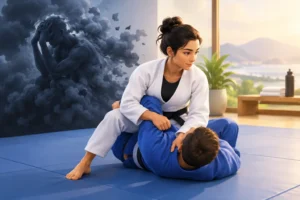
Brazilian Jiu-Jitsu is a grappling art. It teaches you how to control, escape, sweep, and submit an opponent using leverage, positioning, and timing. You spend a lot of training close to another person, learning how to stay calm under pressure and solve problems in real time.
Muay Thai is a striking art. It teaches punches, kicks, knees, elbows, footwork, defense, and clinch work. The pace often feels more explosive, and progress is easier to see early because you can feel the difference in how you move, hit, and condition your body.
That basic contrast shapes everything else. BJJ asks, “What happens when the distance closes?” Muay Thai asks, “How do I manage distance and do damage without taking it back?” Both are demanding. Both build confidence. They just do it through very different problems.
Which Is Better for Self-Defense?
This is where people often want a clean answer, but real self-defense is rarely clean.
BJJ gives you strong tools when a fight becomes physical in close quarters. If someone grabs you, tackles you, or crashes into a clinch, grappling experience matters. BJJ teaches control, positional awareness, and composure when things get chaotic. For smaller people especially, that technical advantage can be a major equalizer.
Muay Thai gives you distance management, striking power, and the ability to stay mobile. If you can avoid getting tied up and create space, striking can end a confrontation quickly or help you disengage. There is also a practical confidence that comes from learning how to deal with incoming punches, pressure, and timing.
The trade-off is simple. BJJ is strongest once contact is made and the fight gets messy. Muay Thai is strongest when you can stay on your feet, control range, and avoid being overwhelmed. Neither art covers every situation by itself. That is one reason cross-training works so well for people who want a more complete skill set.
BJJ vs Muay Thai for Fitness
If your main goal is fitness, both will get you there. The difference is how the work feels.
Muay Thai usually feels harder right away. Pad rounds, bag work, drills, and conditioning push your lungs, legs, shoulders, and core fast. Many beginners leave class feeling like they got a full athletic workout even before they understand the finer points of technique.
BJJ can be deceptive. Some classes feel technical and controlled, then live rounds expose just how much energy grappling takes. You are carrying weight, resisting pressure, framing, bridging, gripping, and trying to think while tired. It builds a different kind of conditioning – less about sharp bursts of impact and more about sustained effort, pressure tolerance, and total-body endurance.
If you want a training style that feels immediately like high-output exercise, Muay Thai often wins that category for beginners. If you want fitness that develops alongside problem-solving and body control, BJJ has a different kind of payoff.
What Learning Feels Like in Each Art
This part matters more than people think because motivation usually follows the training experience.
BJJ is often slower to understand at first. There are many positions, many layers of defense, and many moments where a beginner feels lost. That is normal. The art rewards patience. Over time, small technical improvements start changing everything. Escaping bad positions, surviving longer, then controlling rounds yourself becomes deeply satisfying.
Muay Thai often feels more accessible in the beginning. You can learn a stance, throw a jab, practice a kick, and feel progress on day one. That early clarity helps many beginners stay engaged. Later, the art becomes more technical than people expect. Timing, rhythm, balance, defense, and ring awareness take years to sharpen.
So the question is not which one is easier. It is which learning curve you are more likely to respect. If you enjoy puzzle-solving and gradual mastery, BJJ may fit you better. If you like direct feedback and visible movement progress, Muay Thai may click faster.
Who Usually Connects With BJJ First
People who like strategy tend to stay with Jiu-Jitsu. So do people who want a martial art where size and strength are not the whole story. BJJ attracts analytical thinkers, people who enjoy technical depth, and beginners who may not see themselves as natural strikers.
It is also a strong fit for adults who want realistic self-defense training without starting with punches to the face. Rolling is still intense, but many beginners find grappling less intimidating than sparring with strikes. The challenge is physical, but the environment can feel more controlled while you build confidence.
Parents often appreciate this side of BJJ for kids too. It teaches pressure management, discipline, and composure in a way that carries over well beyond class.
Who Usually Connects With Muay Thai First
Muay Thai often attracts people who want intensity, movement, and a straightforward sense of athletic progress. If you enjoy striking combinations, pad work, and the rhythm of stand-up training, it is easy to see why people fall in love with it.
It is also a great option for people looking to improve conditioning, coordination, and confidence quickly. Learning to hold a stance, defend yourself, and deliver clean technique changes how you carry yourself. That matters in and out of the gym.
Some students simply prefer the pace. Muay Thai feels dynamic. There is less stillness, more range management, and a constant relationship between offense and defense. For many people, that makes training feel sharp and energizing.
If You Are a Complete Beginner, Here Is the Honest Answer
Start with the one you are more likely to keep showing up for.
That may sound simple, but consistency beats theory. The best martial art for you is the one that turns into month two, then month six, then your first real level of confidence. Plenty of people overthink the decision and delay training. Meanwhile, the person who just starts is already building skill.
If you are torn, ask yourself a few honest questions. Do you want to learn how to control physical contact at close range, or do you want to learn how to move, strike, and manage distance? Does the idea of grappling sound interesting or stressful? Does striking sound exciting or intimidating? Your reaction usually tells you something useful.
There is also a practical answer that many experienced coaches will give you: if you have access to strong instruction in both, try both. In a quality academy, beginners do not need to commit for life on day one. They need exposure, good coaching, and a place where they can learn safely.
Why Cross-Training Makes Sense
The bjj vs muay thai debate starts to change once you train long enough. Instead of choosing sides, you begin to see how the arts complement each other.
BJJ helps strikers feel calmer in the clinch and on the ground. Muay Thai helps grapplers become more balanced, more mobile, and more comfortable with distance and pressure on the feet. Together, they create a broader martial arts foundation.
That does not mean everyone should train both immediately. Beginners usually do best when they build confidence in one format first. But once your schedule and recovery allow it, cross-training can sharpen your understanding of both.
That is one of the biggest advantages of learning in a true multi-discipline academy. You are not forced into a false choice between striking and grappling when your long-term development may benefit from both.
How to Choose Without Regretting It
Pick based on your primary goal, not on hype.
If self-defense through control, leverage, and close-range problem-solving matters most, start with BJJ. If fitness, striking confidence, and dynamic movement matter most, start with Muay Thai. If you are equally interested in both, your best first move is to experience a class and pay attention to what keeps your focus.
A good academy will make that decision easier, not harder. You should feel challenged, coached, and respected from the start. That matters just as much as the style itself. At Imperial BJJ Lakewood, that balance is part of the training culture – serious instruction, clear structure, and a community that helps beginners become consistent.
The strongest choice is not the one that sounds toughest online. It is the one that gets you through the door, back in the room, and steadily better week after week.





1 Comment
[…] you want a full-body workout that feels more engaging than a treadmill, kickboxing or Muay Thai may be the right fit. If you are drawn to problem-solving, control, and self-defense at close […]