
Most adults do not start training because they want to become fighters. They start because they want to feel less vulnerable, more capable, and more in control. That is why self defense classes for adults need to offer more than a hard workout or flashy techniques. They need to teach skills you can actually use under pressure, in a way that helps you stay calm, think clearly, and respond with purpose.
A good class should leave you feeling stronger without feeding false confidence. That balance matters. Real self-defense is not about memorizing a handful of moves and hoping they work. It is about awareness, positioning, timing, distance, decision-making, and repetition. It is also about training in an environment where beginners can learn safely and consistently enough to improve.
What adults really need from self defense classes
Many people searching for self defense classes for adults are trying to solve several problems at once. They want practical protection, but they also want fitness, structure, stress relief, and confidence. The strongest programs recognize that these goals are connected.
If you are tired, uncoordinated, and overwhelmed, it is harder to defend yourself well. If you have never practiced controlling space, managing contact, or staying composed when someone is resisting, technique alone will not carry you very far. The right training builds physical ability and mental steadiness at the same time.
This is one reason martial arts-based training often stands out. Instead of treating self-defense like a one-day seminar, it gives you an actual practice. You improve your reactions by training them. You develop confidence by doing difficult things regularly, not by talking about them once.
Not all self-defense training is equally useful
There is a big difference between training that looks impressive and training that prepares you for resistance. Adults should be cautious of programs that rely heavily on scripted sequences, unrealistic attacks, or claims that a few classes are enough.
Useful self-defense training usually includes live practice at an appropriate level. That does not mean chaos or injury. It means learning techniques against partners who move, react, and make you adjust. Without that piece, students often mistake familiarity for competence.
It also helps to train in more than one range. Real confrontations are messy. Some start standing at a distance, where footwork, awareness, and striking matter. Others turn into clinches, takedowns, or ground situations, where balance, escapes, and control become critical. A school that can teach both striking and grappling gives adults a more complete base.
The best self defense classes for adults teach judgment, not just techniques
One of the biggest misconceptions about self-defense is that it is mostly physical. In reality, good judgment is often the first skill. When to create distance, when to disengage, when to use your voice, and when to escalate physically are all part of protecting yourself.
A serious program should respect that reality. It should not glorify conflict or encourage reckless behavior. It should help students understand that the safest outcome is often avoiding the fight altogether. But it should also prepare them for the moment when avoidance fails and action is necessary.
This is where disciplined instruction matters. Adults need training that is mature, measured, and rooted in real mechanics. They do not need fear-based marketing. They need coaching that treats self-defense as a skill set built through patience and accountability.
Which martial arts are most useful for adult self-defense?
The honest answer is that it depends on how the school teaches them. Style matters, but coaching quality, training format, and consistency matter more.
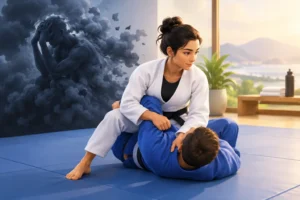
Brazilian Jiu-Jitsu is especially valuable because it teaches control, escapes, leverage, and composure in close contact. For many adults, that is a major confidence builder. If someone grabs you, pushes you, or forces a clinch, grappling knowledge can make the situation feel far less chaotic. It also allows smaller people to learn practical ways to manage larger, stronger opponents.
Striking arts like Muay Thai and kickboxing add another layer. They teach distance, balance, timing, defensive movement, and how to generate force under pressure. Even if your goal is not competition, learning how to manage a standing exchange changes how you carry yourself and how you react.
Judo and wrestling also deserve attention because they build strong base, body control, and takedown awareness. In a real confrontation, understanding how to stay on your feet or off-balance someone else can be a major advantage.
That is why a multi-discipline approach often makes sense for adults. You do not need to become an expert in everything at once. But training in an environment that values both grappling and striking gives you a broader toolkit and a clearer understanding of what happens in different situations.
What beginners should look for in a school
The best school for a beginner is not always the loudest one or the one making the biggest promises. It is the one that can take a brand-new student and help them improve week after week.
Start with the coaching. Are instructors able to explain clearly, correct details, and adapt to different experience levels? Good teachers do not just demonstrate techniques. They build them step by step, give useful feedback, and create structure so students know what they are working on.
Then look at the culture. A serious academy should feel focused, respectful, and welcoming. Beginners should not feel ignored, thrown into the deep end, or pressured to prove themselves on day one. At the same time, the room should still have standards. Progress comes faster when training partners are helpful and the environment values discipline.
It is also worth paying attention to whether the program offers a path forward. Self-defense is not a one-month project. The most effective classes are part of a long-term training system where students can keep building skill instead of plateauing after a few introductory lessons.
Why consistency matters more than intensity
A lot of adults worry that they are too out of shape, too busy, or too old to start. In most cases, that fear fades quickly once they find the right training environment. You do not need to arrive in peak condition. You need a class you can stick with.
One hour of smart training two or three times a week beats an unsustainable burst of motivation every time. Consistency improves timing, coordination, cardio, and confidence in ways that are hard to fake. It also changes how you handle stress. Situations that once felt overwhelming start to feel familiar.
This is where supportive structure matters. A school that welcomes beginners, offers clear instruction, and creates accountability can help adults build momentum fast. Over time, self-defense training becomes more than a skill. It becomes part of how you carry yourself at work, at home, and in unfamiliar environments.
Questions worth asking before you join
Before signing up anywhere, ask how classes are structured and how beginners are introduced. Ask whether students train with live resistance and how safety is managed. Ask what disciplines are offered and whether the academy focuses on practical application or only fitness.
You should also ask yourself a few things. Do you want a narrow self-defense course, or do you want a place where you can keep growing? Do you learn best in highly technical classes, high-energy classes, or a mix of both? Are you looking for a transactional gym, or a community that will challenge and support you?
For many adults in Lakewood and the Denver metro area, the answer is not just finding a place to sweat. It is finding a place where training is taken seriously, beginners are respected, and progress is built on real instruction. That is one reason academies with strong coaching, proven lineage, and multiple disciplines under one roof stand out. At Imperial BJJ Lakewood, that combination gives students the chance to build practical self-defense skills while becoming part of a team that values growth and accountability.
A smart way to think about your first class
Do not judge your first class by whether you felt perfect. Judge it by whether the instruction was clear, the culture was healthy, and the training felt real. Feeling challenged is normal. Feeling lost, dismissed, or misled is not.
Good self-defense training should make you humble, capable, and hungry to learn more. It should show you where your gaps are while giving you confidence that they can be closed. That is a much stronger foundation than hype.
The right class will not just teach you how to react if something goes wrong. It will help you move through daily life with better posture, better awareness, and a steadier mind. That kind of confidence is earned, and once you start building it, you will feel the difference far beyond the mat.



No comment yet, add your voice below!