
Walking into your first jiu-jitsu class can feel like the hardest part. If you have been searching for bjj for beginners near Lakewood, chances are you are not just looking for a workout. You are looking for a place where you can start without feeling behind, get real instruction, and build confidence one class at a time.
That matters more than people think. A beginner does not need a room full of ego, vague coaching, or a trial class that feels designed for people who already know the basics. You need structure. You need coaching that explains why things work. And you need a training environment that takes your first month as seriously as your first competition – even if you never plan to compete.
Why BJJ makes sense for beginners
Brazilian Jiu-Jitsu has a reputation for being technical, and that is exactly why it works so well for new students. You do not have to be the strongest person in the room to make progress. You do not need a fighting background. You do not need to show up in great shape on day one.
What you do need is consistency and a willingness to learn. BJJ gives beginners a clear path. You start with posture, movement, escapes, and control. Over time, those pieces become timing, problem-solving, and confidence under pressure. That progression is one reason so many adults stick with it when they have quit other fitness routines.
There is also a practical side. Good BJJ training improves balance, coordination, conditioning, and self-defense awareness. It teaches you how to stay calm when someone is trying to control you, and that lesson carries over into everyday life. Stress at work, nerves in social situations, and moments of uncertainty all feel more manageable when you have practiced staying composed in a demanding environment.
What to look for in bjj for beginners near Lakewood
Not every academy is built the same, and beginners usually feel the difference right away. Some schools are excellent for advanced competitors but less organized for first-timers. Others are friendly but too casual to produce real progress. The right fit is somewhere in the middle – disciplined, welcoming, and technically sound.
Start with the coaching. A good beginner program should teach fundamentals in a sequence that makes sense. You should hear clear explanations, not just see a move demonstrated at full speed. If an instructor can break down grip placement, body position, and timing in a way that a brand-new student can understand, that is a strong sign.
Culture matters just as much. A serious academy should still feel approachable. New students should be shown where to stand, how to line up, how to partner, and how to train safely. You should not feel ignored because you are new, and you should not feel pressured to prove yourself in your first class.
Then there is the bigger picture. If you are comparing options for BJJ near Lakewood, consider whether the academy has a strong curriculum, qualified instruction, and a community that supports long-term growth. Those things may not sound flashy, but they are what keep beginners turning into consistent students.
What your first few classes will actually feel like
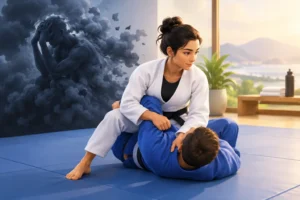
Most beginners expect the hardest part to be the physical training. Sometimes it is. More often, the challenge is mental. You are learning a new language, new movements, and new habits all at once. You may forget the names of techniques. You may get stuck in drills that look simple when the instructor demonstrates them. That is normal.
A strong beginner class should account for that. You should spend time learning base, posture, shrimping, bridging, guard retention, escapes, and positional awareness. These are not glamorous skills, but they are the foundation of everything that comes later. The students who embrace the basics usually improve faster than the ones who only want submissions.
You should also expect a learning curve with live training. Some academies ease beginners into sparring with positional rounds or controlled resistance, while others introduce rolling later. Neither approach is automatically better. It depends on the coaching and how safety is managed. What matters is that beginners are guided, not thrown into chaos.
If you leave your first class tired, a little humbled, and excited to come back, that is a good sign.
The difference between a good academy and a great one
For beginners, the details make the difference. A good academy can teach techniques. A great one teaches standards.
That means classes start on time, instruction is organized, and the room has a sense of purpose. It means students are expected to train with control and respect. It means coaches are paying attention, correcting mistakes, and creating an environment where beginners can improve without feeling overwhelmed.
It also means the academy has real technical depth. Lineage and curriculum are not just words for experienced grapplers to care about. They affect beginners too. When instruction comes from a proven system, your early training is less random. You are not collecting disconnected moves. You are learning how positions connect and why fundamentals matter.
That is one reason many students look for schools with a serious jiu-jitsu affiliation and a reputation for technical teaching. At Imperial BJJ Lakewood, the Demian Maia Jiu Jitsu Brasileiro affiliation reflects exactly that kind of standard – disciplined instruction, strong fundamentals, and a clear path for long-term development.
Is BJJ only for people who want to compete?
Not at all. Some beginners worry that joining a real academy means they are signing up for tournaments, hard sparring, or a room full of aspiring fighters. In a quality program, competition is an option, not a requirement.
Many students train for fitness, self-defense, structure, and personal growth. They want a challenging routine that keeps them accountable and gives them measurable progress. BJJ is excellent for that because it demands attention. You cannot drift through class half-focused. You have to be present.
For other students, the appeal is confidence. There is something powerful about learning how to stay composed in close contact, escape bad positions, and solve physical problems under pressure. That confidence tends to show up outside the academy too.
And for families, BJJ has another benefit. Kids and teens often thrive in structured martial arts environments because the lessons go beyond movement. They learn discipline, respect, and how to handle adversity without folding under it.
How to know if you are ready to start
Most people wait too long. They tell themselves they need to get in shape first, lose weight first, get stronger first, or watch a few more videos first. The truth is simpler. The right time to start is when you are willing to begin as a beginner.
You do not need to know anything before your first class. You do not need expensive gear right away. You do not need perfect cardio. A well-run academy will meet you where you are and help you build from there.
What does matter is your mindset. If you can show up, listen, and stay consistent through the awkward early phase, you are ready. Progress in jiu-jitsu is rarely dramatic from one class to the next. It shows up quietly. You panic less. You remember where your hands should go. You escape positions that trapped you last week. Then one day, you realize you move with a level of confidence that did not exist when you started.
Choosing a place you can stick with
Convenience matters more than people admit. If an academy has excellent instruction but the schedule or location makes it hard to train consistently, your progress will stall. The best beginner program is one you can realistically attend every week.
That is why local students often search for BJJ for beginners near Lakewood instead of just searching for jiu-jitsu in general. They want quality coaching, but they also want a place that fits their life. If you live in Lakewood, Denver, Golden, Arvada, or nearby, choosing a school with strong beginner structure and a supportive culture can make the difference between trying one class and building a real practice.
A free trial can help, but use it wisely. Do not just ask whether the class was hard or whether the people seemed nice. Ask yourself whether the instruction felt organized, whether the atmosphere felt respectful, and whether you could picture yourself training there three months from now.
Starting BJJ is not about becoming someone else overnight. It is about giving yourself a better environment to grow in – one class, one round, and one lesson at a time.




4 Comments
[…] weight, remove useful grips, and force predictable reactions. That is true whether you are a new white belt trying to get through closed guard or an experienced grappler working against a sharp open guard. […]
[…] You do not need to arrive athletic, flexible, or experienced. You need the willingness to learn. A strong beginner program breaks technical skills into manageable steps so progress feels possible from the first class […]
[…] depends on your experience and mobility how quickly these stages progress. A newer student may need several classes of controlled drilling before adding resistance. An experienced grappler […]
[…] a larger training partner or frustrated when a technique does not work. In a well-coached beginner class, those moments are controlled, respectful, and scaled to the student’s experience. You tap when […]