
A child who once stood at the edge of the mat, avoided eye contact, and whispered answers does not need a personality transplant. They need earned proof that they can handle hard things. A kids martial arts confidence example often starts that simply: one class, one safe challenge, one small win that becomes a new way of seeing themselves.
For parents, confidence can feel like a vague goal. You want your child to speak up, make friends, try new activities, and handle setbacks without falling apart. Martial arts gives those goals a structure. Children practice skills, receive clear feedback, work through mistakes, and learn that progress comes from showing up again.
A Kids Martial Arts Confidence Example in Action
Consider a seven-year-old named Mateo. He is bright, kind, and athletic enough to enjoy recess, but he tends to hang back in unfamiliar settings. At school, he rarely volunteers an answer even when he knows it. If another child takes the lead in a game, Mateo lets it happen. When he loses, he gets frustrated quickly and may decide he is “not good at it.”
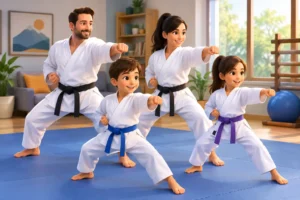
On his first day in a youth martial arts class, Mateo stays close to his parent. During warm-ups, he watches other children before joining in. When it is time to practice a basic movement with a partner, he hesitates. A good coach does not force a big performance. Instead, they give him one clear job: get into a strong stance, keep his hands in position, and practice the movement slowly with a respectful partner.
Mateo completes the drill. It is not dramatic, but the coach recognizes the effort specifically: he listened, stayed focused, and finished what he started. The next week, he remembers the warm-up. A few weeks later, he raises his hand to demonstrate a movement. A month after that, he loses a game during class, takes a breath, and asks to try again.
That is confidence. It is not loudness or the need to dominate other children. It is the growing belief that, even when something feels uncomfortable, he has the ability to respond.
Why the change carries over
The physical skills matter, but the confidence shift comes from the training process. Martial arts places a child in manageable moments of pressure. They must listen, follow directions, work with a partner, and keep trying when a technique does not work immediately.
Each class gives them evidence that effort is useful. They learn that being corrected is not the same as failing. They learn that a stronger or more experienced partner is not a reason to quit. They learn that respect applies whether they win a game, make a mistake, or help someone else improve.
Over time, those lessons can show up outside the academy. A child may speak more clearly when ordering food, walk into a new classroom with less hesitation, or handle a disagreement without immediately shutting down. Results vary from child to child, and martial arts is not a substitute for professional support when a child is dealing with serious anxiety or bullying. Still, consistent training can become a powerful part of a larger confidence-building plan.
What Builds Confidence in Kids Martial Arts
Confidence grows best when children are challenged without being overwhelmed. A quality youth program does not throw a nervous beginner into a situation they are not ready for. It creates a clear path: learn the stance, practice the movement, develop control, apply it in an age-appropriate drill, then build from there.
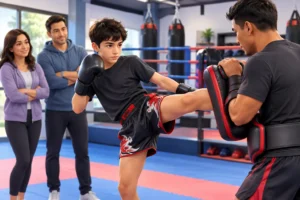
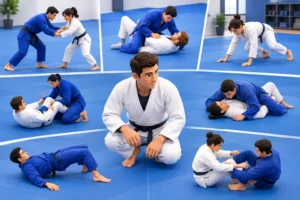
Brazilian Jiu-Jitsu is especially valuable for many children because it teaches leverage, position, problem-solving, and calm decision-making. A smaller child can learn that technique and patience matter. Kickboxing and Muay Thai-style training, when taught with proper control and age-appropriate instruction, can strengthen coordination, focus, and body awareness. Wrestling and Judo-style movement can help children become more comfortable with balance, safe falling, and close-contact problem-solving.
The discipline is only part of the equation. The environment matters just as much. Children need coaches who set firm expectations while making it safe to be new. They need partners who are taught to work carefully. They need a room where respect is practiced, not just mentioned.
At Imperial BJJ Lakewood, youth training is built around that balance: serious instruction, clear standards, and a team culture where beginners can grow without feeling singled out.
The Difference Between Real Confidence and a Bigger Ego
Some parents worry that martial arts will make their child aggressive or overly competitive. The right program should produce the opposite result. Children who feel genuinely capable usually have less to prove.
Real confidence looks like a child using a calm voice, respecting personal space, and walking away when possible. It looks like knowing how to ask an adult for help. It looks like setting a boundary without escalating a situation. Martial arts can support anti-bullying skills because children learn posture, awareness, communication, and controlled responses, not because they are encouraged to seek fights.
Competition can be helpful for some students, especially those who enjoy testing their skills. For others, it may be too much too soon. A strong academy gives children room to train for personal development without making tournaments the only measure of success. The child who stays composed during a difficult drill may be making just as meaningful a breakthrough as the child who earns a medal.
Signs Your Child Is Building Confidence
Parents often expect to see a major change right away. Sometimes that happens, but more often confidence arrives in quieter ways. Your child may start getting ready for class without reminders. They may show a sibling a movement from training, introduce themselves to a new student, or accept coaching with less frustration.
Pay attention to how they talk about difficult moments. A child who used to say, “I can’t do this,” may begin saying, “Can you show me again?” That shift is significant. It shows they are starting to view challenges as something they can work through rather than something that defines them.
You may also notice better emotional recovery. Martial arts does not eliminate disappointment. Children will still miss a technique, lose a game, or have a day when they do not feel their best. The goal is not to protect them from every hard feeling. The goal is to help them reset, learn, and continue.
How Parents Can Support the Process at Home
The strongest support is simple and specific. Instead of asking, “Did you win?” try asking what your child practiced, what felt challenging, or who they worked with. Praise the actions they control: arriving on time, staying respectful, trying again, and listening to their coach.
Avoid turning every class into a performance review. Some children need time to settle into a new group, particularly if they are shy or have had a rough experience in another sport. Consistency usually matters more than intensity. Attending regular classes for several months gives a child the repetition needed to recognize their own growth.
It also helps to let children own part of the routine. They can pack their uniform, fill a water bottle, or remember the habit of arriving ready to learn. Small responsibilities reinforce the same message they hear on the mat: you are capable, and your actions matter.
A confident child is not one who never feels nervous. It is one who learns that nerves can come along for the ride while they still take the next step. Give your child a place to practice that lesson, then notice the quiet courage they bring home with them.



No comment yet, add your voice below!