
A hard round can change how you think about grappling versus striking fast. From across the mat, strikes can feel like the obvious answer. Once someone closes distance, grabs hold, or puts you on the ground, control becomes the problem you need to solve. Neither skill set is optional in a complete martial arts education. The better question is which one serves your goals right now – and how the two can make each other stronger.
For beginners, this is good news. You do not need to arrive with a fighting background or choose an identity on day one. You need quality coaching, a safe room, and the willingness to build skills one class at a time.
Grappling Versus Striking: The Core Difference
Striking uses punches, kicks, knees, elbows, movement, timing, and distance management to create damage or discourage an opponent from moving forward. Kickboxing and Muay Thai teach you to maintain posture under pressure, generate power efficiently, recognize openings, and stay composed while exchanges move quickly.
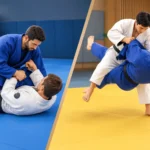
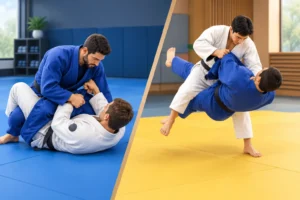
Grappling focuses on clinching, takedowns, positional control, escapes, submissions, and getting back to your feet. Brazilian Jiu-Jitsu, wrestling, and Judo each approach those problems differently, but they share a central idea: position determines what is possible. When you can control an opponent’s movement, you can reduce danger without needing to rely on a bigger or harder strike.
The distinction matters, but it is not a clean divide. A Muay Thai clinch contains grappling. Wrestling needs awareness of strikes in a combat setting. BJJ benefits from understanding how a person can hit from different positions. Martial arts are connected systems, not isolated boxes.
When Grappling Is the Better Starting Point
Grappling is often an excellent entry point for adults who want practical self-defense, confidence, and a demanding full-body workout without beginning with head contact. BJJ gives students a structured way to train against real resistance. You learn what it feels like when another person is stronger, faster, or determined not to let you move – then develop technical answers.
That experience builds calm. A new student may initially panic when pinned underneath someone. With coaching and repetition, they learn to frame, protect their neck, create space, escape, and recover position. The physical lesson is valuable, but the mental lesson may be even more powerful: pressure is manageable when you have a process.
Grappling also rewards patience. A good round is not always about forcing a finish. Sometimes success is holding position, escaping a bad spot, defending a takedown, or recognizing that the safest choice is to disengage. For children and teens, those habits support body awareness, discipline, and controlled confidence without teaching them to seek conflict.
There are trade-offs. Grappling requires close contact, and the learning curve can feel unfamiliar at first. It also does not replace the need to understand distance and how to protect yourself from strikes. If your primary goal is improving your comfort while standing or developing visible striking skills, a striking program may be the more immediate fit.
When Striking Makes the Better Starting Point
Striking is direct, athletic, and deeply satisfying. A well-thrown jab, a clean round kick, or a controlled combination on pads gives beginners immediate feedback. You can feel your coordination improve from class to class. For many people looking to relieve stress, improve conditioning, and build confidence, fitness kickboxing offers an approachable path into martial arts training.
Muay Thai adds a more complete combat-sport framework. Students train punches and kicks alongside knees, elbows, clinch work, defensive movement, and timing. The goal is not to swing wildly or prove toughness. It is to move with balance, protect yourself intelligently, and make disciplined choices while tired.
Striking is especially useful because it teaches range. Before a confrontation ever becomes a clinch or a takedown, distance matters. Can you maintain space? Can you move off line? Can you recognize when an aggressive person is closing in? These are practical skills, and training them develops confidence that carries into everyday life.
The trade-off is that striking has a higher margin for error in live exchanges. Good programs scale intensity carefully, especially for beginners. Technical pad work, drills, controlled partner exercises, and respectful sparring all have a place. Hard contact is never a substitute for skill, and a strong academy protects students while still preparing them honestly.
Why Cross-Training Produces More Complete Martial Artists
The most useful answer to grappling versus striking is often both, taught with purpose. Cross-training helps you understand the transitions that decide many real exchanges. A striker who cannot manage a clinch can be taken off balance. A grappler who has never considered punches may leave openings while entering for a takedown or working from the ground.
You do not need to train every discipline at once. In fact, beginners usually progress faster when they establish a foundation in one program, then add another class as their schedule and recovery allow. Someone might begin with BJJ twice a week, gain confidence in close-range situations, and add kickboxing for conditioning and distance management. Another student may start with Muay Thai, then choose wrestling or Judo to improve balance and clinch control.
The benefit is not merely collecting techniques. It is learning to stay adaptable. You begin to see range, posture, grips, angles, and pressure as connected parts of the same problem. That perspective is valuable for competitors, but it is equally valuable for adults who simply want to be more capable, fit, and composed.
At Imperial BJJ Lakewood, that multi-discipline approach lets students train BJJ, Muay Thai, kickboxing, Judo, and wrestling in one supportive community. The standard is serious instruction, but the environment should never make a new person feel like they have to earn the right to begin.
Choosing Based on Your Goal
If self-defense is your priority, start by being honest about what you want to solve. Grappling teaches you how to escape holds, manage close contact, and control someone without automatically escalating force. Striking teaches awareness of range, movement, and how to create an opportunity to get away. The best self-defense outcome is always avoiding or leaving danger, not winning an unnecessary fight.
If fitness is your priority, either path works. Striking often delivers a fast-paced cardio challenge, while grappling develops grip strength, mobility, core stability, and endurance under resistance. Try both if possible. The program you enjoy enough to attend consistently will do more for your health than the one that looks best on paper.
If competition is your goal, specialization matters more. BJJ tournaments reward positional strategy, submissions, and composure on the ground. Muay Thai and kickboxing develop timing, striking combinations, defense, and ring awareness. Wrestling and Judo sharpen takedowns, balance, and explosive movement. Cross-training remains valuable, but your main ruleset should guide where you spend most of your time.
For parents, the choice may come down to your child’s personality. Some children love the movement and energy of striking drills. Others thrive in the problem-solving side of grappling. In either case, look for coaches who teach respect, control, listening, and confidence. A youth martial arts program should build capable kids, not encourage reckless behavior.
What a Smart First Month Looks Like
Your first month should be about learning the rhythm of training, not proving anything. Expect to practice stance, movement, basic defense, safe falling, positional escapes, simple combinations, and the gym’s rules for working with partners. You may feel awkward. That is normal. Coordination is built through repetition, and confidence follows evidence.
Show up consistently, ask questions, and choose training partners who help you learn. Tap early in grappling. Keep your strikes controlled. Take recovery seriously, especially if you are returning to exercise after time away. Martial arts can be demanding, but the right pace keeps training sustainable.
The goal is not to decide whether you are a grappler or a striker before your first class. It is to become someone who can stay calm, move with purpose, and keep growing when the work gets difficult.



No comment yet, add your voice below!