
Your first Brazilian Jiu-Jitsu class can feel like walking into a room where everyone already knows the rules. People bow before stepping on the mat, pair up quickly, and move with purpose during live rounds. The good news is that the complete guide to beginner BJJ etiquette comes down to a simple standard: respect the room, protect your training partners, and stay ready to learn.
You do not need to know every custom before your first class. A quality academy expects beginners to ask questions and make small mistakes. What matters is showing that you are coachable, clean, controlled, and considerate. Those habits will help you earn trust faster than any athletic ability.
Start With Respect for the Academy
BJJ etiquette begins before instruction starts. Arrive a few minutes early enough to check in, change, and settle in without rushing across the mat while class is already underway. If you are late, enter quietly and follow the academy’s procedure. Some schools ask late students to wait at the edge of the mat for the instructor’s acknowledgment. Others prefer you to join the nearest open space. When in doubt, ask.
Keep shoes off the training surface. Mats are where people put their faces, hands, and bare feet, so cleanliness is not a minor detail. Wear sandals or shoes to the restroom, lobby, and outside areas, then leave them at the edge before returning to the mat.
Listen when the instructor is speaking. That means putting away your phone, avoiding side conversations, and saving unrelated questions for an appropriate moment. If a technique is confusing, ask for help. Good instructors would rather answer a thoughtful question than watch you repeat a movement incorrectly.
Many academies use a bow, lineup, or handshake to open and close class. Follow the lead of the room without overthinking it. These traditions are not about pretending to be someone else. They create a shared standard of attention and respect among people training hard together.
Complete Guide to Beginner BJJ Etiquette on the Mat
The central rule of BJJ is simple: your partner is not a piece of equipment. Every drill and round depends on two people helping each other improve safely. Treat that responsibility seriously.
When partners are chosen, avoid waiting in the corner for the instructor to assign someone. Make eye contact, introduce yourself, and ask someone to train. Training with people of different sizes, ages, and experience levels is part of learning. Still, it is reasonable to let the coach know if you have an injury, are returning after time away, or are unsure about working with a much larger partner.
During drilling, give your partner enough resistance for the technique to make sense, but do not turn a learning repetition into a competition. If the coach says to practice an escape, let your partner work the escape. If you do not understand the movement, pause and ask instead of forcing the position.
Be aware of the space around you. BJJ classes can get crowded, and pairs naturally drift while rolling. If you are about to collide with another group, stop and reset. Do not try to win a scramble by crashing into people. More experienced students may help redirect the action, but every student shares responsibility for keeping the room safe.
Hygiene Is Part of Being a Good Teammate
No one wants to raise the subject, but hygiene is one of the clearest forms of respect in grappling. You train in close contact. Sweat, skin, hair, and fabric all become part of the experience.
Come to class in a clean gi or fresh no-gi clothing. Wash your uniform after every session, not when it starts to smell. Keep your fingernails and toenails trimmed, remove jewelry, and cover any cuts with appropriate bandages. If you have a rash, open wound, contagious illness, or suspected skin infection, stay off the mats until it is safe to return.
Fresh breath matters too, especially during close-range drilling. Deodorant, clean gear, and basic personal care make the academy better for everyone. It may sound obvious, but teammates remember the people who consistently show up prepared.
Roll to Learn, Not to Prove Something
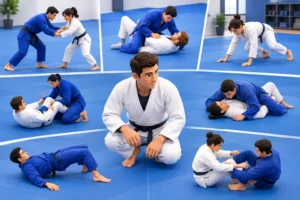
Live sparring, often called rolling, is where beginner nerves can spike. You may feel pressure to show that you are tough, athletic, or hard to submit. Resist that urge. Your first goal is to become a safe, reliable training partner.
Before a round, a quick fist bump or handshake establishes mutual respect. If you are new, tell your partner. If you have an injury, say so before the round begins. A good partner will adapt the pace and avoid putting you in a position that risks aggravating it.
Control is more valuable than intensity. Use technique where you can, and when you cannot, slow down rather than muscling through every exchange. There is a difference between training with purpose and treating a five-minute round like a personal fight. Explosive movements, uncontrolled takedowns, and refusing to release pressure near a wall can injure someone quickly.
Size and experience affect the right pace. A larger beginner should be especially mindful when working with a smaller partner. A smaller student should not feel obligated to accept a round that feels unsafe. If you are unsure, ask the instructor who would be a productive match. That is not weakness. It is sound judgment.
Tap Early and Release Immediately
Tapping is not losing. It is how training stays sustainable.
Tap with your hand on your partner, on the mat, or verbally if your hands are trapped. Tap early when you are caught in a joint lock, choke, or uncomfortable position you do not understand. Waiting to see how far a submission can go is not a test of character. It is how beginners get hurt.
The other half of this rule is just as important: release as soon as you feel or hear a tap. Do not hold on for an extra second. If your partner taps and you are uncertain whether they are okay, give them space and ask. The same applies if they say “stop” or make an unusual sound.
Never crank a submission to force a tap. Apply techniques with gradual pressure and control. In a real situation, a person may not cooperate. In the academy, your partner is trusting you with their body. That trust is more important than finishing a round.
Learn How to Work With Higher Belts
Higher belts are valuable training partners because they can often slow the round down, expose gaps in your game, and keep you safe while doing it. Do not take that as an invitation to use maximum strength. You will learn more by paying attention to what they are giving you and where you repeatedly get caught.
Avoid coaching other beginners unless the instructor has asked you to help. You may mean well, but a new student repeating advice they only half understand can create confusion. Instead, share what helped you if someone asks, or bring the question back to the coach.
If a higher belt gives you feedback, receive it with an open mind. You do not have to agree with every detail immediately, and different coaches may explain techniques differently. But defensiveness slows progress. Try the correction, notice what changes, and keep training.
What to Do When You Make a Mistake
You will forget a name, bump into another pair, use too much strength, or miss part of a drill. Every experienced student has done the same. The right response is brief and mature: apologize, reset, and adjust.
Do not turn a small mistake into a long explanation. If you accidentally land on someone, make sure they are okay. If you are rolling too hard, acknowledge it and reduce the pace. If you repeatedly feel lost, ask for guidance after the instruction is complete. Accountability builds respect quickly.
The same goes for emotions. BJJ can be frustrating because progress is visible in real time. You will get pinned, submitted, and out-positioned. Avoid throwing gear, storming off the mat, or making excuses after every round. Take a breath, thank your partner, and return to class ready to learn.
Build the Kind of Room You Want to Train In
A strong academy is not built only by its instructors. It is built by the people who greet newcomers, train safely, clean up after themselves, and make room for others to improve. Learn names. Thank your partners. Help straighten the mats or return loaner gear when needed. These small actions create the sense of belonging that keeps people training through difficult weeks.
At Imperial BJJ Lakewood, beginners are not expected to arrive polished. They are expected to arrive willing to learn, willing to respect their teammates, and willing to return. Show up clean, train with control, and treat every partner as someone helping you build a better version of yourself. That mindset will carry you much farther than trying to look experienced on day one.



No comment yet, add your voice below!