
The goal of martial arts training is not to prove how tough you are on your first night. It is to return to the mat, ring, or training floor consistently enough to become skilled. Learning how to train martial arts safely starts with that mindset: protect yourself, protect your training partners, and build your ability one well-coached session at a time.
Whether you are trying Brazilian Jiu-Jitsu, Muay Thai, kickboxing, Judo, wrestling, or a combination of disciplines, safety is not separate from progress. Good training habits let beginners gain confidence without being overwhelmed, while experienced athletes can push hard without treating every round like a competition.
Start With Coaching, Not Guesswork
The fastest way to develop bad habits – or get hurt – is to learn complex techniques at full speed without qualified instruction. Martial arts involve timing, leverage, balance, striking range, takedowns, and submissions. Each demands details that are difficult to understand from videos alone.
A quality academy gives students a structured progression. Beginners should learn how to fall, break balance, control distance, tap, hold pads, and spar with intention before adding intensity. Coaches should explain not only what a technique does, but when to use it, where people commonly make mistakes, and how to keep a partner safe while practicing it.
At Imperial BJJ Lakewood, students can train multiple disciplines under experienced instruction rather than piecing together a program on their own. That structure matters. A safe room has clear expectations, attentive coaches, and teammates who understand that everyone is responsible for the culture.
Tell Your Coach What They Need to Know
Let your coach know if you are returning from an injury, managing a medical condition, pregnant, taking medication that affects exercise tolerance, or simply new to intense physical activity. This is not an excuse to sit out. It gives your coach the information needed to offer sensible modifications.
A sore shoulder may mean avoiding certain grips and submissions. A recovering knee may require a different takedown progression. If you have been inactive for years, the smart plan may be fewer rounds with more technical drilling at first. Training safely does not always mean training lightly. It means choosing the right challenge for your current capacity.
Build Intensity Gradually
Most avoidable martial arts injuries happen when intensity outruns skill. A new student may feel fit from running, lifting, or playing another sport, then discover that grappling or sparring uses the body in unfamiliar ways. Strong lungs do not automatically prepare your neck, fingers, joints, or decision-making for live rounds.
Start by showing up consistently two or three times per week. Focus on learning positions, movement patterns, defensive habits, and controlled drilling. Add harder rounds as your conditioning and confidence improve. You do not need to win every exchange to have a productive class.
For striking, begin with footwork, posture, pad work, and light technical sparring when your coach says you are ready. Heavy sparring has a place for some experienced athletes preparing for competition, but it should never be the default measure of progress. Clean technique, control, and awareness beat reckless power.
For grappling, learn to tap early and without embarrassment. A tap is communication, not failure. If a choke, joint lock, or pressure position feels wrong, tap, reset, and ask a question. Waiting to see whether you can escape can turn a safe round into an unnecessary injury.
Choose Partners Who Make You Better
A training partner can make a difficult session safe and productive, or turn simple drilling into chaos. Seek people who match your size, experience, and goals when possible, especially early on. Size differences are not automatically unsafe, but they require more control and better communication.
Before a round, say what you need. You can ask to go light, work on a specific position, avoid a sore area, or keep the pace technical. Good partners respect that immediately. They do not mock a beginner for tapping, crank submissions, throw uncontrolled strikes, or use their size to overwhelm someone who is still learning.
You also need to be that partner for others. If someone is smaller, newer, older, or returning from time away, adjust your pace. Release a submission the moment they tap. Keep your strikes controlled. Help create the kind of room where parents feel comfortable bringing their children and adults feel comfortable starting from zero.
Learn the Safety Rules of Your Discipline
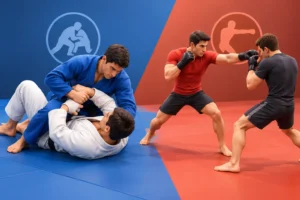
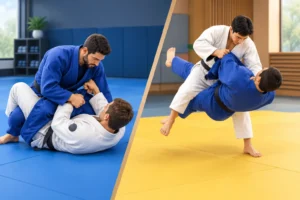
Every martial art has its own risk profile. In Brazilian Jiu-Jitsu, safe training includes tapping early, avoiding sudden twisting pressure on joints, and keeping fingers out of clothing or grips where they can get caught. In Judo and wrestling, proper breakfalls and controlled takedown entries are essential. In Muay Thai and kickboxing, mouthguards, shin protection when appropriate, controlled contact, and intelligent sparring protect both athletes.
Some rules are universal. Keep your nails short and clean. Cover cuts and report skin concerns. Shower promptly after training and wash your gear after every session. Wear clean clothing, remove jewelry, and keep your mouthguard and protective equipment in good condition.
Hygiene may not sound as exciting as learning a throw or a head kick, but it is a basic sign of respect. Clean mats and clean gear reduce the risk of common skin infections and help keep the entire team training consistently.
Warm Up for the Work You Are Actually Doing
A useful warm-up prepares you to move, not just to sweat. Before class, give yourself a few minutes to increase your heart rate and move the joints you will use. Think hip mobility for kicking and guard work, shoulder movement for grappling, ankle mobility for footwork, and gradual neck activation for contact sports.
During class, pay attention to the technique-specific warm-up. Drilling hip escapes, breakfalls, stance movement, sprawls, or light shadowboxing teaches movement while preparing the body for greater speed. Save long static stretches for after training or separate mobility work. Before explosive effort, your body generally responds better to active movement and controlled ranges of motion.
If something causes sharp pain, numbness, dizziness, or instability, stop and tell a coach. Normal training discomfort can include fatigue, muscle soreness, and the challenge of learning under pressure. Sharp pain and strange symptoms are different signals.
Recover Like Training Is a Long-Term Commitment
Progress happens between classes as well as during them. Sleep, hydration, protein, balanced meals, and rest days all affect your ability to learn and stay resilient. If you are constantly exhausted, sore in the same place, or losing enthusiasm because every class feels like survival, reduce your volume or intensity for a week and reassess.
Do not use painkillers to hide an injury so you can keep sparring. Do not ignore a concussion concern after a hard impact. Seek appropriate medical guidance when symptoms persist, worsen, or affect normal movement. A few days of caution can prevent a problem that sidelines you for months.
Recovery also includes managing expectations. Some weeks you will feel sharp. Other weeks, work, parenting, travel, or stress will limit what you can do. Showing up for a technical class, drilling carefully, and leaving healthy is still meaningful progress.
How to Train Martial Arts Safely as a Beginner
Beginners often worry that they need to become fitter before joining a martial arts academy. Training itself is how you build fitness, coordination, confidence, and discipline. You only need the willingness to learn, listen, and pace yourself.
Arrive early enough to meet the coach and mention that you are new. Ask questions when instructions are unclear. Focus on posture, breathing, and basic defense instead of trying to memorize every detail. Keep your ego out of sparring, and measure success by what you learned rather than how many rounds you dominated.
The safest martial artist is not the one who avoids hard work. It is the one who respects the process, trains with awareness, and gives themselves enough time to grow. Find a team that holds high standards while making room for beginners, then keep coming back ready to learn.




No comment yet, add your voice below!