
Most beginners do not walk into a jiu jitsu academy feeling confident. They walk in unsure of what to expect, a little self-conscious, and usually convinced everyone else already knows what they are doing. That is exactly why understanding how beginners build confidence through jiu jitsu matters. Confidence in this sport is not something you fake. It is something you earn, one class, one round, and one small win at a time.
Jiu jitsu has a reputation for being intense, but for new students, its real value often shows up in quieter ways. A person who used to avoid physical challenges starts showing up consistently. Someone who felt uncomfortable speaking up begins asking questions. A teenager who doubted themselves begins moving with more certainty. A parent who wanted better stress relief starts feeling more capable in everyday life. Those changes are not accidental. They come from a training process that teaches people how to stay composed under pressure and keep improving even when they are uncomfortable.
Why jiu jitsu builds real confidence
There is a difference between confidence based on talk and confidence based on proof. Jiu jitsu gives beginners proof.
From the first week, students are exposed to clear feedback. A technique either works or it does not. A posture is either stable or it breaks down. You either escaped the position or you did not. That kind of honesty can feel humbling at first, but it is also what makes progress meaningful. When a beginner finally performs a clean escape, controls a position, or remembers a sequence under pressure, they know they earned it.
That matters because real confidence usually grows from competence. People feel better about themselves when they can do hard things with control. In jiu jitsu, those hard things are measurable. You can see your reactions improve. You can feel your breathing settle. You notice that situations that once felt chaotic now feel manageable.
How beginners build confidence through jiu jitsu in the first months
The early stage of training is rarely smooth. Beginners often expect to feel stronger and more coordinated right away. Instead, they discover how much there is to learn. Timing is unfamiliar. Positions feel awkward. Rolling with more experienced students can be frustrating.
This is where good instruction and the right culture make a difference. Beginners build confidence fastest when they are taught that struggle is part of the process, not evidence that they are failing. A solid academy helps new students understand what progress actually looks like. Sometimes progress is not submitting someone. Sometimes it is staying calm in side control, remembering to frame properly, or lasting an entire round without mentally checking out.
Those early wins matter. They give beginners a new standard for success. Instead of judging themselves against advanced students, they start noticing their own improvement. That shift is powerful. It turns training from something intimidating into something rewarding.
Confidence comes from surviving pressure
One of the most valuable things jiu jitsu teaches is how to stay present when pressure shows up.
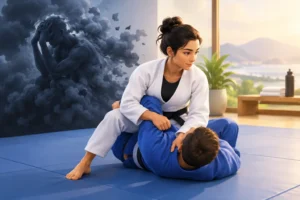
For beginners, that pressure is physical and mental. Maybe someone is holding them down. Maybe they are stuck in a bad position. Maybe they are tired and want to panic. In everyday life, many people respond to pressure by freezing, avoiding, or rushing. Jiu jitsu gives them a safer place to practice a better response.
Over time, students learn that pressure does not always mean danger. Sometimes it means slow down, breathe, and solve the problem in front of you. That lesson carries beyond the mat. People who train regularly often find that stressful meetings, uncomfortable conversations, and daily setbacks feel more manageable. Not because life got easier, but because they became steadier.
That is one reason jiu jitsu confidence tends to be more durable than surface-level motivation. It is built through repeated exposure to challenge, followed by proof that challenge can be handled.
Skill changes how people carry themselves
Beginners are often surprised by how much jiu jitsu changes body language.
As coordination improves, posture improves. As conditioning improves, movement becomes more deliberate. As students learn how to grip, base, frame, and control space, they stop moving like people who expect to be overwhelmed. They begin to carry themselves with more awareness.
This does not mean they become aggressive. Usually the opposite happens. People who feel capable tend to act calmer. They do not need to prove anything. They are less reactive because they are less intimidated.
That can be especially meaningful for adults who have spent years feeling disconnected from athletic spaces, and for kids or teens who need a healthier sense of self. When someone sees that they can learn demanding skills in a structured environment, their identity starts to shift. They stop seeing themselves as the person who is always behind, too nervous, or not athletic enough.
The role of community in beginner confidence
Confidence grows faster when people feel like they belong.
A good jiu jitsu academy is competitive in the right ways, but it is also supportive. Beginners need training partners who challenge them without trying to crush their motivation. They need coaches who correct mistakes clearly without making them feel small. They need an environment where showing up as a true beginner is normal.
That sense of belonging matters more than many people realize. Starting martial arts can feel vulnerable. You are learning in front of others. You are making mistakes in real time. If the room feels cold or ego-driven, many beginners shut down. If the room feels disciplined, respectful, and encouraging, they stay long enough to improve.
This is where culture separates a serious academy from a casual workout space. Strong coaching standards matter, but so does the feeling in the room. For many students, confidence begins the moment they realize they are not being judged for being new. They are being taught.
Fitness helps, but it is not the whole story
Physical improvement absolutely plays a role in confidence. Beginners often gain stamina, mobility, grip strength, and overall conditioning within the first few months. They feel healthier. They move better. They start trusting their bodies more.
But confidence through jiu jitsu is not just about looking fitter or feeling tougher. If it were, any hard workout would do the same job. Jiu jitsu adds another layer because it requires problem-solving, composure, and technical growth. It asks beginners to think while tired, adjust while uncomfortable, and stay disciplined when progress is slow.
That combination is what makes the confidence stick. A person is not just getting into better shape. They are becoming more capable under stress.
What can slow confidence down
There are trade-offs, and it helps to be honest about them.
Some beginners compare themselves too much. Others train inconsistently and then feel discouraged when progress is slower than expected. Some come in expecting immediate self-defense mastery and get frustrated by the learning curve. Jiu jitsu can absolutely build confidence, but only if the student gives the process enough time.
It also depends on training environment. A technically strong academy with poor beginner support may produce good competitors, but not necessarily confident new students. On the other hand, a very friendly environment without structure may feel comfortable but leave people stagnant. The best result comes from both – high standards and real support.
That balance is a major reason many new students do better in an academy that combines world-class instruction with a welcoming culture. At Imperial BJJ Lakewood, that blend is a big part of what helps beginners stay consistent long enough to feel the change.
Confidence for adults, teens, and kids looks different
Adults often come to jiu jitsu wanting confidence, but what they really want is trust in themselves again. They want to know they can handle discomfort, commit to something difficult, and become more capable than they were a month ago.
Teens often need something slightly different. They benefit from challenge, structure, and a place where discipline is expected. Confidence for them often grows through accountability. They learn to show up, listen, work hard, and improve without constant reassurance.
For kids, confidence is usually built through small visible victories. Learning how to fall correctly, escape a hold, follow directions, and work with a partner can have a huge impact. It teaches them that being nervous is normal and that skills can be built through practice.
The method changes by age, but the pattern stays the same. Confidence grows when students face challenge, receive guidance, and experience earned progress.
What beginners should expect
If you are starting jiu jitsu, expect to feel awkward before you feel confident. That is normal. Expect to forget techniques, get tired, and need repetitions. Also expect small breakthroughs that seem minor from the outside but feel huge to you.
You may notice that after a few weeks you are less tense during drills. After a month or two, you may stop apologizing every time you make a mistake. Later, you may realize you are handling hard rounds and hard days with a different mindset. Those are all signs that confidence is being built where it actually counts.
The best part is that this kind of growth rarely stays on the mat. When beginners commit to jiu jitsu, they usually came for fitness, self-defense, or curiosity. What they often keep is a stronger relationship with challenge itself. And that changes much more than a workout routine ever could.


No comment yet, add your voice below!