
Typing free martial arts trial near me into a search bar usually happens for a reason. Maybe you want a better workout that does not bore you after two weeks. Maybe your child needs confidence, structure, and a positive outlet. Maybe you have been meaning to learn real self-defense and are finally ready to walk through the door.
A free trial is a smart place to start, but not every martial arts school offers the same experience. Some are built for cardio and entertainment. Others are built for skill, discipline, and long-term progress. The right trial should help you feel welcome while also showing you the standard of instruction, the culture of the room, and whether you can see yourself training there consistently.
What a free martial arts trial near me should actually tell you
The trial is not just about getting one free class. It is your chance to answer a bigger question: is this a place where you or your child can grow?
That means looking beyond the surface. A clean lobby and an energetic coach matter, but they are only the starting point. Pay attention to how classes are run. Are beginners given clear guidance, or left to copy people who already know what they are doing? Is the training structured, or does it feel improvised? Are students challenged without being thrown into something they are not ready for?
A strong academy makes that balance look natural. It should feel serious without feeling cold. You should notice standards, but also support. For families, the same rule applies. Kids need discipline and accountability, but they also need a coaching environment that builds confidence instead of fear.
Not all martial arts trials are built the same
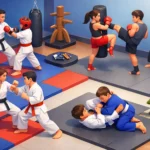
If you are comparing schools, it helps to know what kind of training you are actually stepping into. Martial arts is a broad category, and your trial experience will depend on the program.
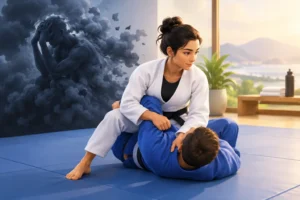
Brazilian Jiu-Jitsu is centered on leverage, control, timing, and problem-solving under pressure. It is one of the clearest paths for practical self-defense because it teaches how to manage distance, escape bad positions, and control an opponent without relying on size alone. A beginner trial in BJJ should introduce you to basic movement and positioning in a way that feels challenging but manageable.
Muay Thai and kickboxing are striking arts. They build conditioning, coordination, and confidence fast. A good first class usually focuses on stance, basic punches, kicks, and pad work rather than trying to overwhelm you with combinations. If your goal is fitness with real skill behind it, these programs can be a strong fit.
Judo and wrestling develop balance, takedowns, pressure, and body control. These arts can be especially valuable if you want a complete grappling foundation. For kids and teens, they also build toughness and discipline in a very concrete way.
That is why a multi-discipline academy often gives people a better long-term home. You are not forced into a single lane before you understand what you enjoy or what you need most.
What beginners should expect on day one
A lot of adults hesitate because they assume a trial class will be intense, awkward, or embarrassing. In a well-run school, it should be none of those things.
You should expect a coach or staff member to explain where to go, what to wear, and how the class will work. You may start with a warm-up, basic technique instruction, and partner drilling. In some programs, there may be live training, but beginners should be introduced carefully and with clear boundaries.
The first class often feels unfamiliar, and that is normal. You are learning a new language with your body. The question is not whether everything makes sense immediately. The question is whether the coaches can teach in a way that makes progress feel possible.
If you are bringing your child, the same principle applies. A strong youth class should be organized, age-appropriate, and high in structure. Kids should be active and engaged, but the room should not feel chaotic. Look for instructors who can hold attention, correct behavior, and still keep the class encouraging.
How to judge a school during your free martial arts trial near me search
Most people focus on schedule and price first. Those matter, but they should not be the only filters. The better questions go deeper.
Start with coaching quality. Are the instructors technically sharp and able to break things down clearly? High-level experience matters, but teaching skill matters just as much. A coach can be accomplished and still be poor at guiding beginners.
Then look at culture. Do higher-level students help newer people? Is there mutual respect on the mat? Does the room feel ego-driven, or growth-driven? Good schools create an atmosphere where people train hard without trying to prove something every minute.
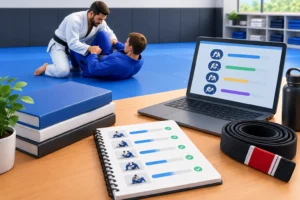
Finally, look at progression. Ask yourself whether the academy has a clear path beyond the first class. Can an adult beginner keep building week after week? Can a child move from early confidence to real discipline and skill? A trial should give you a glimpse of that future, not just a temporary sales pitch.
Why lineage and curriculum matter more than most people realize
This is one area many first-time students overlook. They assume all martial arts instruction is roughly the same if the class feels fun and the reviews look decent. That is not always true.
In technical arts like Brazilian Jiu-Jitsu, lineage matters because it reflects coaching standards, curriculum depth, and connection to a proven method of teaching. A school that is part of a respected affiliation is often able to offer more consistent instruction and a clearer development system. That matters for competitors, but it also matters for complete beginners. Good structure shortens the learning curve and builds confidence faster.
Curriculum matters for families too. Parents are not just paying for activity. They are investing in coaching, character development, and a positive environment. A school with a real teaching framework will usually deliver stronger results than one that simply runs kids through drills to burn energy.
That is one reason many Denver-area students look for academies that offer both serious martial arts credibility and a welcoming entry point. At Imperial BJJ Lakewood, for example, students can start with a 7-day free trial while stepping into a program shaped by Demian Maia Jiu Jitsu Brasileiro affiliation, structured coaching, and multiple disciplines under one roof.
Common concerns before you start
A lot of people worry they need to be in shape first. You do not. Training helps you get in shape. The better academies know how to meet beginners where they are and build them up over time.
Others worry they are too old, too inexperienced, or too far behind. That depends on your goal. If you expect to perform like an advanced student on day one, yes, you will be frustrated. If your goal is to improve steadily, age and experience matter a lot less than consistency.
Parents often worry about safety. That is a fair concern. Martial arts should challenge kids, but it should not throw them into reckless training. Ask how classes are supervised, how skills are introduced, and how coaches manage behavior. Good youth programs make safety part of the structure, not an afterthought.
How to get the most out of your trial
Show up a little early and be honest about your goals. If you want fitness, say that. If you want self-defense, say that. If your child is shy, energetic, or new to group activities, mention it. A good coaching team can guide the experience better when they know what matters to you.
Wear comfortable workout clothes unless the academy tells you otherwise. Bring water, stay open-minded, and do not judge the entire experience by whether you felt smooth right away. Most people do not. What matters is whether the environment makes you want to come back and improve.
After class, ask yourself a few simple questions. Did the instruction make sense? Did you feel respected? Could you picture training there next month, not just today? The best trial classes leave you tired, interested, and confident that there is a real path forward.
Finding the right school is not about chasing the flashiest ad or the hardest workout. It is about choosing a place where skill, discipline, and community come together in a way that keeps you showing up. When that happens, a free trial stops being a test class and starts becoming the first step in something that lasts.



No comment yet, add your voice below!