
Walking through the doors for your first martial arts class can feel like the hardest part. You may be wondering what happens during a free trial class, whether everyone will be more experienced than you, or if you need to be in great shape before you begin. The answer is simple: your first visit is designed to help you get comfortable, learn how the academy works, and experience real training at a pace you can handle.
At a quality martial arts academy, a free trial is not a test of toughness. It is your opportunity to see whether the coaching, culture, and programs are the right fit for your goals. Whether you want to improve your fitness, learn practical self-defense, help your child build confidence, or return to competition, you should leave your first class with a clear sense of what training can add to your life.
What Happens During a Free Trial Class?
Most free trial visits begin with a warm welcome and a quick conversation. An instructor or team member will ask what brought you in and what you hope to achieve. Maybe you are looking for Brazilian Jiu-Jitsu, Muay Thai, kickboxing, wrestling, Judo, or a youth program for your child. Sharing your goals helps the coaching team point you toward the right class and give you useful guidance from the beginning.
You will also have time to ask practical questions. If you have an old injury, limited training experience, concerns about contact, or a busy family schedule, bring it up. Good coaches want to know what will help you train safely and consistently. Martial arts should challenge you, but the challenge should be appropriate for where you are starting.
For most beginner classes, you do not need to arrive with specialized gear. Wear clean athletic clothes that allow you to move comfortably, bring water, and arrive a few minutes early. If you are trying Brazilian Jiu-Jitsu, the academy may provide a loaner uniform or explain what to wear for a no-gi class. For striking programs, gloves and other equipment are often available to borrow for your first session. Confirm the details before you arrive so you can focus on training rather than logistics.
You Will Start With a Structured Warm-Up
A martial arts warm-up has a purpose beyond getting sweaty. You may move through light cardio, mobility work, basic bodyweight movements, and drills that prepare your joints and coordination for the class ahead. This gives instructors a chance to see how you move while helping you settle into the room.
Do not worry if you do not know every movement right away. Beginners are expected to learn by watching, asking questions, and repeating the basics. You will not be the first person to confuse right and left, forget a sequence, or need an extra demonstration. Consistency matters far more than looking polished on day one.
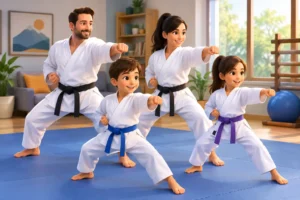
Parents watching a youth trial will often notice the same structure, adapted for age and attention span. Younger students may warm up through movement games and coordination exercises, while older kids begin learning the focus and discipline that martial arts requires. The goal is not just to keep children active. It is to teach them how to listen, persist, and work respectfully with others.
The Instructor Teaches Fundamentals, Not Tricks
The main portion of a free trial class usually centers on a foundational skill. In Brazilian Jiu-Jitsu, that could mean learning a safe stance, how to fall properly, a basic escape, positional control, or how to move effectively on the ground. In Muay Thai or fitness kickboxing, you may practice footwork, basic punches, defensive positioning, and controlled pad work. Wrestling and Judo classes may focus on balance, grips, movement, and safe technique before more advanced takedowns are introduced.
This is where professional instruction matters. A strong curriculum breaks complex movements into clear steps, explains why the technique works, and gives students time to practice it with supervision. You should not feel rushed into hard sparring, heavy contact, or advanced rolls simply to prove yourself. There is a difference between serious training and being thrown into the deep end.
The first class may feel mentally demanding because you are learning a new language with your body. That is normal. Martial arts asks you to coordinate posture, balance, timing, breathing, and awareness at once. You do not need to master every detail in a single session. Your job is to stay present, practice with intention, and take one useful lesson with you.
Training Partners Help You Learn Safely
Martial arts are individual pursuits practiced in a team environment. During a trial, you may pair with an instructor, an experienced student, or another beginner to drill the techniques. The right partner will work at a controlled pace, explain what they are doing, and help you understand the movement without making you feel overwhelmed.
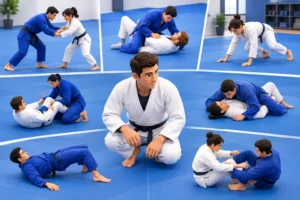
In grappling classes, controlled live training may be offered after technical instruction, but it depends on the program, the instructor, and your comfort level. Some beginners are ready to try a light, supervised round. Others benefit more from drilling fundamentals first. Neither choice says anything about your potential. Smart training is about building a foundation you can return to week after week.
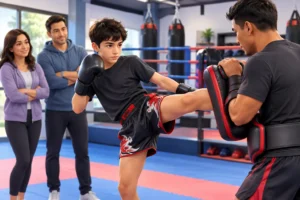
The same principle applies to striking. Your first session may include pad rounds or light partner drills, but a well-run class will prioritize technique, distance, and control. You should never feel pressured to take unnecessary hits or work beyond a safe intensity level.
Expect a Serious Room With a Supportive Culture
A good academy has standards. Students bow or line up when appropriate, treat training partners with respect, listen when the instructor speaks, and keep the space clean and safe. Those expectations are part of what makes martial arts powerful. They create an environment where people can train hard without ego taking over.
At the same time, a disciplined room should be welcoming. Experienced students remember what it was like to be new. They know that confidence is built through repeated effort, not handed out at the door. For adults, that sense of belonging can be the difference between trying one class and finding a long-term practice. For children, it can become a positive community outside school where effort, respect, and resilience are recognized.
Imperial BJJ Lakewood brings that balance to its programs: technical instruction rooted in the Demian Maia Jiu Jitsu Brasileiro lineage, with a culture that supports beginners, families, and serious athletes under one roof.
After Class, You Can Decide What Comes Next
Once class ends, take a moment to notice how you feel. You may be tired, energized, challenged, or surprised by how much you enjoyed the learning process. You will likely have questions about class schedules, program options, equipment, and how often you should train. Ask them. A trial is meant to give you honest information, not pressure you into a decision before you are ready.
A 7-day free trial gives you more than one snapshot of the academy. One class can show you the instruction style, but several visits reveal how the community feels, how the curriculum progresses, and which discipline fits your goals best. You might come in expecting to try fitness kickboxing and discover a passion for Brazilian Jiu-Jitsu. Or you may find that cross-training in grappling and striking gives you the variety and structure you have been missing.
For parents, a trial week also provides a chance to see how your child responds to coaching and routine. Look beyond whether they perform every technique perfectly. Notice whether they stay engaged, recover after a mistake, show respect to teammates, and leave with a sense of pride. Those are the habits martial arts is built to strengthen.
Your first class does not require you to be fearless, athletic, or experienced. It only asks you to show up willing to learn. Give yourself permission to be a beginner, pay attention to how the coaches and students treat one another, and choose the training environment that makes you want to return.



No comment yet, add your voice below!