
A self-defense situation does not look like a highlight reel. It is fast, stressful, close-range, and full of variables you cannot control. That is why the question of muay thai versus kickboxing for self defense deserves more than a simple answer about which style has harder strikes. Both can build real confidence and capable striking. The better choice depends on how you train, what ranges you prepare for, and whether your goal is to get home safely rather than win a fight.
Muay Thai Versus Kickboxing for Self Defense: The Core Difference
Muay Thai and kickboxing both teach you how to strike with power, move under pressure, manage distance, and stay composed while someone is trying to hit you. Those are valuable skills for personal safety. A person who has trained consistently usually has better balance, awareness, conditioning, and decision-making than someone who has never dealt with physical resistance.
The main technical difference is that traditional Muay Thai uses eight points of contact: fists, shins, knees, and elbows. It also places major emphasis on the clinch, where fighters control posture, disrupt balance, and use knees or off-balancing techniques at close range.
Kickboxing is a broader term. Depending on the gym and ruleset, it may include punches and kicks, with knees allowed in some formats and restricted in others. Clinching is often limited or quickly separated by the referee. Many kickboxing programs place a strong emphasis on combinations, footwork, speed, timing, and striking from the outside.
Neither approach is automatically superior. The quality of coaching, the consistency of your attendance, and the amount of realistic partner training matter more than the label on the class schedule.
Why Muay Thai Has Strong Self-Defense Advantages
Muay Thai is often well suited to the messy ranges that can develop in an assault. If someone crowds you, grabs clothing, crashes into you, or swings wildly from close distance, long kicking combinations may not be available. Muay Thai gives students tools for working when space disappears.
The Clinch Is a Major Difference
The Muay Thai clinch teaches posture, head position, hand fighting, and balance. Rather than freezing when an attacker gets close, a trained student learns to frame, control, create separation, and move toward an exit. The goal in self-defense is not to stand in front of someone and trade knees. It is to avoid being tied up, knocked off balance, or held in place.
This training can be especially useful because many untrained confrontations become clinches quickly. People grab, shove, tackle, or throw looping punches. Understanding how to keep your base and regain posture can make a meaningful difference.
Elbows and Knees Work at Short Range
Elbows and knees are powerful close-range weapons, but they require judgment. In a real confrontation, their use may be justified only when you face an immediate threat and cannot safely disengage. Training them is still valuable because it teaches you what is available when a person is within arm’s reach.
A responsible academy teaches control first. Students should learn mechanics on pads and through carefully supervised drilling, not treat dangerous techniques as casual sparring tools. Good Muay Thai develops restraint alongside confidence.
Conditioning for Pressure
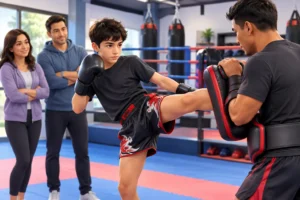
Muay Thai classes commonly include pad work, bag rounds, partner drills, clinch rounds, and controlled sparring. That structure improves your ability to function while tired and uncomfortable. For self-defense, this matters. Adrenaline can make even simple movements feel difficult. Familiarity with pressure helps you breathe, think, and move with more purpose.
Where Kickboxing Shines for Personal Safety
Kickboxing can be an excellent self-defense foundation, particularly for beginners who need to develop efficient striking fundamentals. Strong kickboxing instruction teaches students to keep their hands up, manage range, move their feet, throw clean punches, and avoid standing still after they strike.
Distance Management and Fast Hands
The safest confrontation is the one you avoid. If you cannot avoid it, creating enough space to leave is usually the next best outcome. Kickboxing footwork and punch combinations can help you understand distance, angles, and timing. A sharp jab, a direct cross, or a simple combination may create the opening needed to escape.
Kickboxing also tends to spend substantial time on boxing fundamentals. For many students, this builds practical hand speed and defensive awareness quickly. You learn to see punches coming, cover appropriately, and respond without panicking.
Simplicity Helps Under Stress
Complex techniques can fail when fear and adrenaline take over. A well-taught kickboxing program gives students repeatable basics: stance, guard, movement, straight punches, low kicks, and defensive reactions. These skills can be drilled thousands of times until they become more natural.
That does not mean kickboxing is limited. It means its best self-defense value often comes from reliable fundamentals. A clean, balanced response is more useful than a complicated technique you have never trained against resistance.
The Limits of Both Styles
It would be irresponsible to claim that Muay Thai or kickboxing makes someone invincible. Street violence can involve concrete, uneven terrain, multiple people, weapons, surprise attacks, or legal consequences. Even a skilled striker can be injured, taken down, or caught in a situation that no martial art can fully control.
High kicks are a good example. They are effective in a competitive setting when trained properly, but they can be risky on slippery ground, in tight clothing, or when you do not know whether another person is nearby. For self-defense, lower-risk tools such as movement, verbal boundaries, awareness, palm strikes, low-line kicks, and getting away often make more sense.
Both styles are also primarily striking arts. If someone grabs you, tackles you, or takes the encounter to the ground, grappling experience becomes extremely valuable. This is where cross-training can change the equation.
The Best Self-Defense Plan Is Not One Style
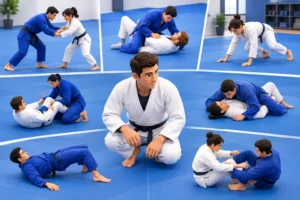
For many adults in Lakewood and the Denver metro area, the strongest long-term approach is to train striking alongside grappling. Muay Thai or kickboxing can teach you how to manage space and defend yourself while standing. Brazilian Jiu-Jitsu, wrestling, or judo can help you understand grips, takedowns, escapes, and how to get back to your feet if you are knocked down.
At Imperial BJJ Lakewood, students can build that wider skill set under one roof. The purpose is not to collect techniques. It is to become more adaptable, more composed, and more capable of making smart decisions when a situation becomes physical.
Cross-training also exposes weaknesses in a healthy way. A striker may learn that staying upright against a determined grappler takes practice. A grappler may learn that closing distance safely is much harder when strikes are involved. This honest feedback creates better martial artists and more practical self-defense students.
What to Look for in a Self-Defense-Focused Class
When choosing between Muay Thai and kickboxing, visit the academy and watch how training is conducted. The most useful class is not necessarily the loudest or the most intimidating. Look for coaching that balances intensity with safety and gives beginners a clear path forward.
Ask whether students practice with partners, not only bags and cardio drills. Pad work builds mechanics and fitness, but controlled partner training develops timing, distance, reactions, and composure. Sparring should be supervised, progressive, and appropriate for experience level. New students do not need to be thrown into hard rounds to gain real skills.
Also pay attention to culture. A supportive room does not mean an easy room. It means training partners respect one another, coaches correct unsafe habits, and people are encouraged to improve without ego. Consistency is what turns a few useful techniques into dependable ability.
So, Which Should You Choose?
Choose Muay Thai if you want to develop close-range tools, clinch awareness, knees, elbows, and a highly complete striking system. It is especially compelling for students who want to feel capable when an encounter gets crowded or chaotic.
Choose kickboxing if you are drawn to fast-paced striking, boxing combinations, footwork, and building confidence from the outside range. A quality kickboxing class can be a practical, approachable entry point for someone who wants fitness and usable skills at the same time.
If both options are available, try each one. The right program is the one you will attend consistently, train seriously, and enjoy enough to keep showing up. Self-defense confidence is built one disciplined class at a time – through awareness, control, good training partners, and the judgment to leave whenever you can.



No comment yet, add your voice below!