
A hard round ends, you stand up, and your knee feels wrong. Not sore from effort – wrong. Most martial arts injuries do not begin with one dramatic moment. They build when fatigue, rushed technique, ego, and poor recovery get treated as normal parts of training. Effective martial arts injury prevention is not about avoiding challenge. It is about training hard enough to improve while making decisions that keep you on the mat for the long term.
For beginners, that starts with accepting that control is a skill. For experienced athletes, it means recognizing when an extra round helps your preparation and when it only adds wear. Whether you train Brazilian Jiu-Jitsu, Muay Thai, wrestling, Judo, or kickboxing, the goal is the same: build a capable body without gambling with it.
Martial Arts Injury Prevention Starts Before Sparring
The safest round is usually decided before anyone touches gloves or grips a lapel. Arrive with enough time to move, breathe, and mentally shift into training. Walking in cold, stressed, dehydrated, and determined to “make up for it” with a brutal session is a common recipe for preventable problems.
A useful warm-up should raise body temperature, prepare the joints you will use, and rehearse the patterns class requires. For grappling, that may include hip movement, bridges, technical stand-ups, shoulder mobility, and controlled breakfalls. For striking, it should include ankle and hip mobility, light shadowboxing, footwork, and gradual practice of rotational movements.
Static stretching alone is not a warm-up. Long holds can have a place after class or in a separate mobility routine, but your pre-training priority is controlled movement. Start easy, then add range, speed, and intensity in stages. If your shoulder pinches during a light drill, a hard round is not going to solve it.
Your equipment matters, too. Use gloves and shin guards that fit, keep your nails short for grappling, wear a clean uniform or training gear, and use a properly fitted mouthguard for contact training. Clean gear and good hygiene are part of injury prevention because skin infections can take you out of training just as effectively as a sprain.
Technique Is Your Best Protection
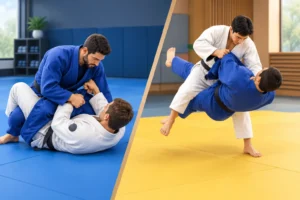
Technical training is not only about winning exchanges. It is how you distribute force safely. A well-timed breakfall reduces the impact of a throw. Good posture in a takedown lowers the chance of your neck or lower back absorbing a bad position. Proper punching mechanics protect your hands, wrists, elbows, and shoulders as well as the person holding pads.
This is why beginners should resist the urge to train at competitive intensity before they can perform the movement with consistency. Speed can hide poor mechanics for a while. Under fatigue, it exposes them.
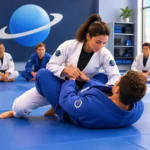
In Brazilian Jiu-Jitsu, tap early and release immediately when your partner taps. There is no prize for seeing how long you can endure pressure on a joint or a choke coming on. A tap is not a failure. It is clear communication that protects your training future and preserves trust with your partner.
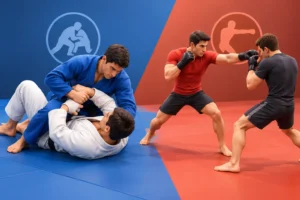
The same principle applies in striking. Technical sparring is not a lighter version of a fight where everyone secretly tries to win. It is an agreement to help each other develop timing, defense, composure, and clean technique. Match your power to your partner’s experience, size, and stated goals. A newer student may need room to learn distance and defend, while a competitor may need more demanding rounds. Neither approach is better in every setting. The coach, the class objective, and both athletes’ consent should set the pace.
Choose Training Partners With Care
A good training partner is one of the strongest safety tools in the room. Look for people who communicate, control their movements, and respond appropriately when you say something hurts or you need to slow down. Be that partner for others.
Before a round, a simple conversation can prevent confusion: Are you going light? Are you working a specific position? Is there an injury to avoid? This is especially valuable when there is a large difference in size, age, experience, or athletic background.
Do not confuse recklessness with toughness. The partner who cranks submissions, ignores taps, throws uncontrolled power, or turns every drill into a contest is not helping you improve. Speak with an instructor if a pattern continues. Strong academies set clear expectations around respect, control, and accountability.
Build Training Volume Gradually
Many injuries happen when motivation outruns conditioning. A new student feels energized after the first week and suddenly adds five classes, heavy lifting, running, and hard sparring to a schedule that previously had little exercise. The body often needs more time than enthusiasm allows.
Increase frequency and intensity in measured steps. If you are returning after time away, begin with technical classes and shorter rounds before chasing your old pace. If you are preparing for competition, higher training volume may be appropriate, but it should be planned around recovery rather than piled onto every available hour.
Pay attention to changes that raise risk: poor sleep, a stressful work week, a recent illness, unusual soreness, a new strength program, or a sharp increase in sparring. You do not need to cancel training every time you feel tired. You may simply need to drill instead of roll hard, attend a fundamentals class instead of an open mat, or reduce the number of rounds.
A simple weekly approach helps. Include hard sessions, technical sessions, strength or conditioning work, and at least one genuine recovery day. The exact balance depends on your goals. A parent attending two evening classes has different needs than a tournament athlete training six days a week.
Recover Like Training Counts
Recovery is where your body adapts to the work you did. Sleep is the foundation. Consistent sleep supports coordination, reaction time, tissue repair, and decision-making – all of which matter when someone is trying to sweep, throw, or strike you.
Eat enough to support your workload, particularly protein and carbohydrates around demanding sessions. Drink water throughout the day, not only when class starts. Colorado’s dry climate can make dehydration easy to overlook, especially after a full day at work or school.
Minor soreness is normal. Sharp pain, swelling, instability, numbness, loss of strength, or pain that changes how you move is different. Do not try to “train through” symptoms that alter your mechanics. Compensating for a sore knee can create a hip or back problem; protecting a painful shoulder can change how you fall or frame.
When something is not improving, seek qualified medical guidance. A coach can modify training and help you work around an issue, but coaching is not a substitute for diagnosis or treatment from an appropriate healthcare professional.
Injury Prevention for Young Martial Artists
Kids benefit from martial arts when training is structured, age-appropriate, and supervised. The focus should be coordination, listening, safe falling, body awareness, confidence, and respect – not forcing adult-level intensity onto a developing athlete.
Parents can help by making sure children arrive rested, hydrated, and ready to participate. Let instructors know about recent injuries, medications, or health concerns that may affect class. Teach your child that telling a coach about pain is responsible, not embarrassing.
For young students, a positive training culture is especially important. They should learn that tapping, taking a break, and following safety rules are signs of maturity. Confidence grows when children know they can challenge themselves in a room where coaches and teammates are looking out for them.
Know When to Stop the Round
Discipline sometimes means stepping off the mat. Stop immediately after a suspected concussion, severe headache, dizziness, confusion, neck pain, a joint that looks deformed, inability to bear weight, or any injury involving numbness or tingling. Do not return to contact training after a suspected concussion until you have been evaluated and cleared by a qualified medical professional.
For less urgent concerns, adjust early rather than waiting for a small problem to become a long layoff. Tell your coach what you are feeling. Ask for positional drilling, lighter pad work, reduced rounds, or a movement-focused class. Smart modifications keep your routine intact while respecting the healing process.
At Imperial BJJ Lakewood, safety is not separate from serious training. It is built into technical instruction, controlled partner work, and a community where students can ask questions without pretending they are invincible.
The best training habit is simple: leave enough in the tank to come back tomorrow. Protect your body, respect your partners, and let steady practice – not reckless sessions – build the confidence and skill you came for.



No comment yet, add your voice below!