
The first victory in an adult beginner martial arts success story often happens before the first class begins. It happens when someone who has spent months thinking, “I am too out of shape,” “I am too old,” or “I will look ridiculous,” decides to walk through the door anyway.
They may arrive in borrowed athletic clothes, unsure how to tie a belt, uncertain where to stand, and convinced everyone else has it figured out. A few months later, they are moving with more confidence, recognizing positions, throwing cleaner combinations, and greeting training partners by name. That change is not magic. It is what happens when consistent effort meets the right coaching and community.
Success Does Not Start With Feeling Ready
Many adults believe martial arts success belongs to people who started as children, competed in school, or already know how to exercise. That belief keeps capable people on the sidelines.
The reality is that beginners do not need to arrive with flexibility, cardio, coordination, or combat experience. They need a willingness to learn. Good instruction meets students where they are, then gives them a clear path forward: learn the fundamentals, practice safely, return consistently, and improve one detail at a time.
For one adult beginner, the starting point might be fitness. They are tired of workouts that feel repetitive and lonely. Another may want practical self-defense skills after feeling vulnerable in public. Someone else may be looking for structure after a stressful season at work. The reason for starting matters, but it does not have to be perfect or dramatic.
What matters is finding training that gives the person a reason to come back next week.
What an Adult Beginner Martial Arts Success Story Really Looks Like
A real success story is rarely a fast montage from the first class to a championship podium. For most adults, progress is quieter and more meaningful.
It is the student who used to need several breaks during warmups but now finishes the round. It is the person who once avoided eye contact walking into class but now helps welcome a new member. It is the beginner who freezes during live training, then one day remembers to breathe, frames properly, escapes a bad position, or stays composed under pressure.
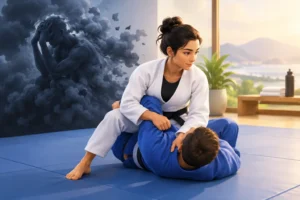
In Brazilian Jiu-Jitsu, success may look like learning to stay safe and calm while grappling with a resisting partner. In Muay Thai or fitness kickboxing, it may be developing balance, timing, and the ability to hold good form when tired. In wrestling or judo, it may be learning how to fall correctly, maintain posture, and use technique rather than panic or force.
These skills build on each other. The body gets stronger, but so does the decision-making. Students begin to understand that discomfort is not always danger and that improvement comes from staying present long enough to solve the problem in front of them.
The Confidence Is Earned, Not Given
Martial arts can build confidence, but not the loud kind that depends on being the toughest person in the room. The confidence that lasts comes from evidence.
A student shows up when they are nervous. They learn a movement that felt impossible. They train with people of different ages, sizes, and experience levels. They make mistakes, adjust, and return. Over time, they have proof that they can handle challenge without quitting.
That confidence often follows people outside the academy. They may speak up more clearly at work, set healthier boundaries, manage stress with more patience, or feel more comfortable in their own body. Martial arts does not remove every difficult moment from life. It gives people a disciplined way to meet those moments.
Why Consistency Beats Natural Talent
The adults who make the biggest changes are not always the most athletic on day one. They are usually the ones who develop a realistic routine.
Training twice a week can create remarkable progress when it becomes consistent. One class helps a beginner learn the lesson. The next class helps them remember it under a little pressure. Over months, those repetitions become habits. The new student who once had to think through every step starts to move with purpose.
There will be missed classes. Work trips, sick kids, sore muscles, and busy schedules are normal. Success does not require a flawless attendance record. It requires returning after interruptions without turning one missed week into a reason to stop altogether.
This is where a supportive academy matters. Serious training should have standards, but it should not make a beginner feel punished for being new. The best room is one where experienced students train hard while still making space for questions, safe rounds, and steady development.
Choosing the Right Starting Point
Adults sometimes delay starting because they think they must choose the “best” martial art before they ever take a class. There is no single answer. It depends on what keeps you motivated and what goals matter most.
Brazilian Jiu-Jitsu is a strong fit for people drawn to technical problem-solving, positional control, and close-range self-defense. Muay Thai develops striking fundamentals, conditioning, and composure while learning punches, kicks, knees, and elbows. Fitness kickboxing can be an approachable entry point for adults who want a high-energy workout with practical striking mechanics. Judo and wrestling build balance, takedowns, body awareness, and the ability to control distance.
Cross-training can be valuable, especially for students who want a more complete skill set. Still, beginners do not need to do everything at once. Starting with one program and establishing a sustainable habit is often smarter than committing to an ambitious schedule that disappears after two weeks.
At Imperial BJJ Lakewood, adults can train across grappling and striking disciplines under one roof while building their foundation at a pace that makes sense for their goals.
The Hard Part Is Also the Point
Every martial arts student reaches a stage where progress feels slow. The techniques are more detailed, training partners feel harder to deal with, and the initial excitement has been replaced by the work of becoming competent.
That stage is not a sign that martial arts is failing you. It is often the point where the most valuable growth begins.
A beginner may compare themselves to a teammate who has trained for years and decide they are behind. But martial arts is not a race with a shared finish line. The experienced teammate is evidence of what consistent practice can create, not proof that a new student does not belong.
Ask better questions instead. Did you handle a round more calmly than last month? Are you recovering faster? Do you understand why a technique worked or failed? Can you train hard while taking care of your partners? Those are meaningful markers of progress.
Your Story Begins With One Class
No adult beginner needs to prove they deserve to train before stepping on the mat. You do not need to get in shape first. You do not need expensive gear, a competitive background, or a personality built for fighting.
You need a place that teaches with patience, expects effort, and treats every student with respect. From there, the small wins begin to add up: one class attended, one technique understood, one difficult round finished, one new connection made.
The strongest success story may not be the one that impresses strangers. It may be the moment you realize you are no longer waiting to become a more confident, disciplined person. You are practicing how to be one.




No comment yet, add your voice below!