
A self-defense situation does not arrive with a warm-up, a referee, or a clear set of rules. That is why learning how to train for self defense means preparing for more than a favorite technique. You need awareness, physical skills, decision-making under stress, and the judgment to leave when leaving is possible.
Good training should make you more capable without making you reckless. The goal is not to win an argument or prove toughness. It is to recognize danger early, create an opportunity to get away, and protect yourself or someone in your care when there is no safer option.
Start With the Real Goal of Self-Defense
Self-defense is about getting home safely. That sounds simple, but it changes how you train. A competition match may reward control, points, or submission skills. A self-defense encounter may involve uneven footing, tight spaces, surprise, multiple people, or a person who does not follow any rules.
Your first line of defense is prevention. Pay attention to your surroundings, trust the feeling that something is off, keep distance from escalating conflicts, and avoid getting pulled into unnecessary confrontations. Verbal de-escalation and a quick exit are not signs of weakness. They are signs of mature judgment.
Physical training matters because awareness is not a guarantee. A situation can develop fast, and confidence comes from knowing you have practiced useful responses with resistance. The key word is practiced. Watching a few videos or memorizing a sequence is not the same as building skills you can use while tired, surprised, and under pressure.
Build a Base in Striking and Grappling
A complete self-defense foundation includes both striking and grappling. You cannot predict whether you will need to create distance, protect yourself at close range, stay on your feet, or escape from underneath someone. Training one range only leaves a gap.
Learn to protect yourself while standing
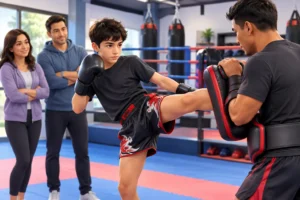
Striking training teaches posture, balance, distance, and how to keep your hands in a position that protects your head. Boxing, kickboxing, and Muay Thai can help you develop footwork, defensive movement, clinch awareness, and controlled power.
For self-defense, the highest-value standing skills are often simple: managing distance, covering up, moving off line, breaking grips, and creating enough space to escape. You do not need a complicated highlight-reel combination. You need balance and composure when another person is moving toward you aggressively.
Training with a qualified coach also teaches restraint. Power without control can create legal, medical, and personal consequences. A responsible gym emphasizes that force must be proportional to the threat and that the safest choice is always to disengage when you can.
Learn what to do when the fight gets close
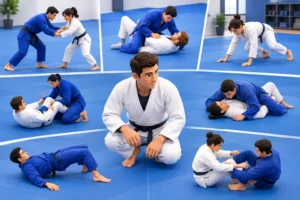
Many real confrontations become clinches, shoves, grabs, or takedowns. Brazilian Jiu-Jitsu, wrestling, and judo develop the ability to maintain balance, defend takedowns, escape bad positions, and control another person without immediately relying on strikes.
That does not mean you should plan to take a fight to the ground. Ground fighting can be dangerous when hard pavement, weapons, or additional attackers are involved. But if you are knocked down or trapped underneath someone, grappling training can give you a path to protect yourself, get up, and leave.
A strong program should teach positional awareness before chasing advanced submissions. Learn how to fall safely, frame against pressure, escape common holds, stand up without exposing yourself, and use the clinch to regain control of space. Those skills translate well because they are built through repetition against partners who are actively trying to stop you.
Train Under Safe, Progressive Resistance
The difference between a technique that looks effective and one you can apply is resistance. If a partner stands still and cooperates every time, almost any move can appear perfect. Training partners who offer measured, appropriate resistance reveal where your timing, balance, and reactions need work.
Progressive resistance does not mean going as hard as possible on day one. Beginners should start with clear drills, technical feedback, and cooperative repetitions. As their movement becomes more reliable, they can add intensity through controlled sparring, positional rounds, clinch work, and scenario-based practice.
A quality academy creates an environment where people can train seriously without needing to prove themselves every round. You should be able to ask questions, tap when needed, reset safely, and learn from experienced partners. That culture is especially valuable for beginners, teens, and adults returning to fitness after time away.
Develop Fitness That Holds Up Under Stress
You do not need to become a professional fighter to improve your ability to protect yourself. You do need enough strength, mobility, and conditioning to move with purpose when adrenaline hits.
Focus on practical athletic qualities: strong legs for balance and movement, a stable core, grip strength for clinch and escape situations, and cardiovascular conditioning that lets you recover after a burst of effort. Martial arts classes naturally build much of this, especially when you attend consistently. Adding basic strength work can help, but the best plan is the one you can maintain.
Do not confuse exhaustion with effective training. Hard sessions have value, but every workout should have a purpose. Some days are for learning details. Some are for conditioning. Some are for controlled sparring. Progress comes from showing up week after week, not from crushing yourself once and disappearing for a month.
Practice Decision-Making, Not Just Techniques
Self-defense training should include the moments before physical contact. Practice setting verbal boundaries in a calm, clear voice. Learn to keep your hands up in a non-threatening position that still protects you. Notice how your distance changes when someone crowds you, grabs clothing, or blocks your path.
Scenario training can be useful when it is realistic and responsibly coached. It should teach recognition, escape, and judgment rather than encourage fantasy solutions. For example, a useful drill may involve responding to a wrist grab, creating space, and moving toward an exit. An unhelpful drill may promise one move that defeats every possible attack.
Consider your own daily reality. A parent may need to think about protecting a child while moving toward safety. A college student may want confidence walking to a car after class. Someone who works late may need better awareness around parking lots and entrances. The best training plan reflects the situations you are most likely to encounter, without letting fear run your life.
Choose a School That Lets You Train Consistently
The right martial arts school should feel challenging, organized, and welcoming. Look for coaches who can explain why a technique works, adjust instruction for beginners, and maintain clear safety standards. Ask whether students practice live resistance, whether striking and grappling are both available, and how the academy handles different experience levels.
Cross-training is especially valuable for self-defense because each discipline solves a different problem. Striking helps you manage range. Wrestling and judo help with balance and takedowns. Brazilian Jiu-Jitsu builds survival and escape skills when the encounter becomes close or goes to the ground. Training these areas under one roof also makes consistency easier.
At Imperial BJJ Lakewood, students can develop this kind of well-rounded foundation through Brazilian Jiu-Jitsu, Muay Thai, fitness kickboxing, and judo/wrestling instruction in a community built around discipline and respect. You do not need prior experience to begin. You need a willingness to learn, train safely, and keep coming back.
A Practical Weekly Training Plan
For most beginners, two to three martial arts classes per week is enough to make meaningful progress. One class can focus on grappling fundamentals, one on striking or kickboxing, and a third on the area where you need the most work. If your schedule is tight, start with two sessions and protect those appointments like any other commitment.
Outside class, spend a small amount of time on mobility, walking, basic strength, or easy conditioning. Review key movements mentally: maintaining a protective stance, creating distance, falling safely, framing, standing up, and leaving. Short, regular practice is more valuable than occasional marathon workouts.
Track progress by more than belt rank or how hard you train. Are you calmer during drills? Do you recover your balance faster? Can you recognize when to disengage? Do you feel more comfortable setting a boundary? Those are meaningful signs that your training is working.
Keep Your Confidence Grounded
Real self-defense skill should make you quieter, not louder. As you become more capable, you may find less need to posture, argue, or test yourself. You understand that even a small confrontation can carry serious consequences.
Train with humility, choose training partners who help you improve, and give yourself time. Confidence is built one class, one round, and one disciplined decision at a time. The strongest habit you can develop is simple: prepare seriously, stay aware, and always make getting safely home the priority.




1 Comment
[…] responsible self-defense instruction starts with avoidance. The best outcome is leaving a dangerous situation early, getting help, and […]