
A first tournament can be decided before the opening handshake. A competitor who does not know how points are earned may celebrate a sweep that did not stabilize, chase a submission that is illegal in their division, or give away a penalty while trying to escape. Understanding BJJ competition rules gives you a calmer mind, clearer decisions, and a better chance to show the skill you have built in training.
The first thing to understand is that there is no single rulebook for every Brazilian Jiu-Jitsu event. Many gi tournaments use a format closely based on IBJJF rules, while submission-only events, local opens, and no-gi organizations may score positions differently or use overtime. Always read the rules for your specific event, division, age bracket, and belt level. Your coach can help you interpret the details, but the responsibility to know what is allowed belongs to every competitor.
BJJ Competition Rules Start With Your Division
Your bracket is usually built around belt rank, age, weight, and sometimes experience level. Tournament weigh-ins can be strict. Some events require you to weigh in wearing your gi, while others weigh competitors without it. If the limit is 170 pounds and the event uses a gi weigh-in, showing up at 170 pounds without accounting for the uniform can remove you from the bracket before you compete.
Check whether your division has an absolute bracket as well. An absolute groups competitors by belt or age without regard to weight, which can be a valuable challenge but is not required for a productive first competition experience.
Uniform requirements matter in gi competition. Your gi must be the approved color for that organization, clean, in good condition, and sized correctly. A loose or torn gi may fail inspection. No-gi events generally require fitted shorts without pockets and a ranked rash guard or approved apparel. Remove jewelry, keep nails short, and bring a backup gi if you have one. These small details are part of competing with discipline and respect for your opponent.
How Points Are Scored in Gi Jiu-Jitsu
In traditional point-based gi events, position matters because dominant positions create control and meaningful submission opportunities. A common scoring structure awards two points for a takedown, sweep, or knee-on-belly position; three points for passing the guard; and four points for mount or back control.
Points are not awarded simply because you touched a position. You generally need to establish and control it for a short period, often three seconds. That is why a fast guard pass is not automatically worth three points if your opponent immediately recovers guard. The same principle applies to mount and the back. Secure the position, settle your weight, and prevent the escape before you assume the score is yours.
A takedown usually scores when you bring your opponent down and establish top control. If you pull guard, you are choosing bottom position rather than scoring a takedown. If your opponent initiates a takedown and you reverse them during the exchange, the referee’s interpretation of control and who completed the action becomes important.
A sweep is a reversal from a guard or bottom position that puts you on top. Not every scramble from the bottom earns sweep points. In most rulesets, you need to begin with a recognized guard and finish in top control. Learning this distinction changes how you compete. Instead of rushing to stand after a reversal, you may need to stabilize on top long enough for the score to register.
Position Before Urgency
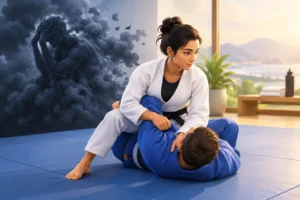
New competitors often make the same mistake: they reach a good position, then attack so quickly that they give it back. If you pass the guard, pause long enough to establish chest-to-chest control. If you take the back, lock your control before hunting the choke. Tournament jiu-jitsu rewards composure.
That does not mean you should stall. It means you should make every transition deliberate. The best competitors know when to apply pressure, when to advance, and when an aggressive movement is not worth sacrificing a lead.
Advantages, Penalties, and Referee Decisions
Some tournaments use advantages to recognize a near-completed scoring action or a serious submission threat. Other events have removed advantages or use different tie-breaking systems. Do not assume the scoreboard works the same way at every tournament.
Penalties are more consistent in purpose even when the details vary. They exist to keep matches active, fair, and safe. Common reasons for penalties include passivity, intentionally leaving the competition area, refusing engagement, grabbing illegal parts of the uniform, or using prohibited techniques.
Stalling can be frustrating because it is subjective. A referee may warn a competitor who stays in a closed guard without attacking, holds a position without attempting to improve, or repeatedly backs away to avoid contact. If you are ahead on points, intelligent defense is allowed. Deliberately avoiding jiu-jitsu is not.
Out-of-bounds situations also deserve attention. Do not rely on stepping outside the mat to escape a bad position. Depending on the event, the referee may stop the action, reset athletes in the center, award points if the scoring movement was already established, or issue a penalty when an athlete intentionally exits the area.
Legal Submissions Depend on Belt and Ruleset
A submission is not automatically legal because you learned it in class or watched it succeed at a professional event. Legality changes according to belt level, age, gi versus no-gi format, and tournament organization.
For example, lower belt divisions commonly have restrictions on heel hooks, kneebars, toe holds, cervical locks, wrist locks, twisting leg attacks, and certain takedowns. Reaping the knee may also be prohibited in some divisions and legal in others. A technique that is acceptable in an advanced no-gi ruleset may lead to immediate disqualification in a beginner gi bracket.
The safest approach is simple: ask your coach which attacks are legal for your exact division, then compete within the game plan you have prepared. Do not test the referee’s interpretation of a leg lock in the middle of a close match.
Safety is also your responsibility when applying legal submissions. Apply pressure with control, release immediately when your opponent taps, and do not continue cranking after the referee stops the match. Likewise, tap early if you are caught. A tournament medal is never worth an injured joint or a missed season of training.
Know the Match Clock and Win Conditions
Match lengths vary by age, belt, and organization. A white belt adult match may be shorter than an advanced division final, and youth matches are typically shorter still. Ask how long your match is before you step on the mat so you can manage your pace.
In a point-based format, you win by submitting your opponent, finishing with more points, or winning under the event’s tie-break rules. In submission-only formats, a submission may be the only guaranteed win in regulation. If neither athlete finishes, the match could be declared a draw, decided by referee criteria, or move to an overtime format.
This difference should shape your preparation. A points match may reward a strong takedown, a controlled pass, and disciplined top pressure. A submission-only match can demand more urgency from both athletes. Neither format is better. They simply ask different questions of your jiu-jitsu.
A Better First-Tournament Plan
Your goal at a first tournament should not be to prove that you belong. You already belong because you prepared, showed up, and stepped onto the mat. Set a process goal instead: get a grip you trust, attempt your best takedown or guard pull with purpose, recover calmly if you land underneath, and listen for your coach’s voice.
Arrive early enough to check in without rushing. Eat familiar food, warm up with controlled movement, and avoid exhausting yourself in the bullpen. Bring water, snacks, identification, your uniform, and any event-required documents. Most importantly, expect nerves. Adrenaline is normal. A steady breathing routine and a simple first-exchange plan can turn nervous energy into useful focus.
At Imperial BJJ Lakewood, competition preparation is built on more than hard rounds. It includes technical awareness, positional discipline, respect for the rules, and teammates who help you grow through the experience. Whether you compete once or build a long-term competitive path, knowing the rules lets your jiu-jitsu speak clearly when the match begins.
Read the event rules one more time the night before, then trust your training. Compete with control, protect your training partners and opponents, and treat every match as a chance to return to the academy sharper than you arrived.




No comment yet, add your voice below!