
A good martial arts school changes what you do with the hard parts of your week. It gives adults a demanding, productive outlet after work. It gives kids a place to practice focus when distractions are everywhere. And it gives both a community where showing up, being coachable, and working through discomfort mean something. That is what people should look for when searching for Arvada martial arts – not just a workout, but training with a purpose.
The right program will challenge you without making you feel like you need prior experience to walk through the door. Whether your goal is better fitness, practical self-defense, competitive skill, or a stronger routine for your child, the most valuable academy is one that can meet you at your current level and steadily raise the standard.
What Great Arvada Martial Arts Training Looks Like
Martial arts are not one-size-fits-all. A person looking to lose weight may need a different starting point than an experienced grappler preparing to compete. A shy six-year-old needs a different coaching approach than a teenager who wants more confidence at school. Still, the strongest programs share a few traits: structured instruction, coaches who pay attention, a safe training culture, and a clear path forward.
Technique should come before intensity. Beginners do not need to be thrown into the toughest room on day one. They need to learn how to stand, move, fall safely, defend themselves, and work with a partner. As those fundamentals improve, training can become more demanding. This approach helps students build real skill rather than relying on athleticism or sheer effort.
A healthy gym culture matters just as much. Martial arts involve close contact, correction, and moments when you do not get the result you wanted. The best training partners help one another improve. They train hard while respecting limits, welcome newcomers, and understand that every black belt once had a first class.
Choose a Style That Matches Your Goal
The word martial arts covers a broad range of training. Before choosing a school, consider what you want your time on the mat or floor to accomplish. You may eventually enjoy several disciplines, but having a clear starting goal makes the decision easier.
Brazilian Jiu-Jitsu for Control and Problem-Solving
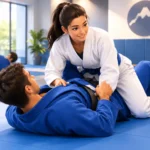
Brazilian Jiu-Jitsu is a grappling art centered on position, control, escapes, and submissions. It is especially valuable for people who want practical self-defense skills without relying on striking. Students learn how to manage distance, stay calm under pressure, and use leverage intelligently.
BJJ is also deeply engaging because it feels like physical problem-solving. You may use the same technique for months, then suddenly understand the timing that makes it work. That process builds patience and humility along with conditioning. For adults who are tired of routine gym workouts, it offers a reason to keep coming back.
Quality instruction is particularly important in Brazilian Jiu-Jitsu. Details such as posture, grips, balance, and pressure determine whether a movement is effective and safe. Training in a curriculum with proven technical standards can make a major difference, especially during your first year.
Muay Thai and Kickboxing for Conditioning and Confidence
Fitness kickboxing and Muay Thai develop striking mechanics, conditioning, coordination, and composure. Pad work, bag rounds, footwork drills, and controlled partner exercises provide a full-body workout while teaching useful movement patterns.
There is a trade-off to consider. If your only goal is calorie burn, a high-energy kickboxing class may be the fastest fit. If you want a deeper striking system that includes clinch work, elbows, knees, defensive movement, and more technical progression, Muay Thai may be a better long-term path. Many students start with fitness goals and find that the discipline and skill development become equally important.
Good striking classes are controlled, not chaotic. Coaches should teach proper alignment, help students build power gradually, and make clear when contact is appropriate. You can train hard without treating every round like a fight.
Judo and Wrestling for Takedowns and Athletic Development
Judo and wrestling focus on balance, takedowns, clinch control, and the ability to dictate where an encounter takes place. These skills complement Brazilian Jiu-Jitsu well, particularly for students who want to feel more capable from a standing position.
They can also be physically demanding. Learning to fall safely and moving through takedown exchanges take time. For athletes, that challenge can be a major benefit. For adults returning to exercise after a long break, the right academy should offer progressive coaching rather than expecting you to keep pace with seasoned wrestlers immediately.
Why Cross-Training Makes a Difference
One discipline can be enough to create meaningful change. But a multi-discipline academy gives students room to grow without needing to find a new gym when their interests expand. Grappling teaches control and close-range awareness. Striking develops distance management and movement. Wrestling and judo add the ability to deal with clinches and takedowns.
Cross-training does not mean doing everything at once. A beginner may be better served by attending Brazilian Jiu-Jitsu two or three times each week until the basics feel familiar, then adding a striking class. Someone seeking fitness may enjoy alternating kickboxing and grappling. Competitive athletes may structure their week around the ruleset they are preparing for.
The advantage is choice. Your training can evolve as your confidence, schedule, and goals change.
What Families Should Expect From Youth Martial Arts
For parents, martial arts should offer more than an hour of activity after school. A strong youth program teaches children how to listen, follow directions, handle frustration, and treat training partners with respect. Those lessons carry into classrooms, team sports, and home life.
Confidence is often the most visible change. Children who practice a skill consistently begin to carry themselves differently. They learn that mistakes are not a reason to quit. They are information. When a technique fails, they adjust, ask questions, and try again.
Age-appropriate coaching is essential. Younger children benefit from clear routines, movement-based learning, and simple goals. Older kids and teens can take on more technical instruction, conditioning, and leadership responsibility. No matter the age, safety and supervision should never be treated as secondary to toughness.
Martial arts can also support anti-bullying awareness. The goal is not to encourage children to fight. It is to help them recognize unsafe situations, use their voice, maintain boundaries, and have the confidence to seek help. Physical skills are most valuable when paired with judgment and self-control.
How to Evaluate an Academy Before You Join
The first visit tells you a lot. Notice whether the coaches greet new people, explain the class structure, and make time for questions. Watch how advanced students work with beginners. A serious academy should have high standards, but serious does not have to mean cold or intimidating.
Ask how beginners are introduced to sparring or live training. In Brazilian Jiu-Jitsu, controlled rolling is a vital learning tool, but it should be supervised and matched appropriately. In striking classes, clarify whether sessions emphasize bags and pads, technical drills, or sparring. There is no single right answer, but the school should be transparent about its process.
Look at the schedule realistically, too. The best program on paper cannot help if class times do not work with your life. Choose a place you can attend consistently. Two focused sessions every week will produce more growth than an ambitious plan that lasts ten days.
For residents of Arvada who want access to Brazilian Jiu-Jitsu, Muay Thai, fitness kickboxing, judo, wrestling, and youth programs under one roof, Imperial BJJ Lakewood offers structured coaching backed by the Demian Maia Jiu Jitsu Brasileiro affiliation. That lineage reflects a commitment to technical excellence, while the academy culture gives beginners and experienced students a place to train with purpose.
Start Before You Feel Fully Ready
Most people do not feel ready for their first martial arts class. They worry about fitness, coordination, age, or whether everyone else will be more experienced. Those concerns are normal, and they disappear faster once you step onto the mat.
Wear comfortable athletic clothes, arrive with an open mind, and focus on learning one thing at a time. A 7-day trial gives you enough time to experience the coaching, meet the community, and see how training fits into your routine. The goal is not to prove anything in your first class. It is to begin building a habit that makes you stronger, steadier, and more capable long after the initial nerves are gone.



No comment yet, add your voice below!