
A child who hesitates to join a team sport may light up the moment they learn a clean breakfall, escape a pin, or help a classmate practice a technique. When parents ask about bjj or judo for kids, they are usually looking beyond martial arts styles. They want a program that builds confidence, discipline, fitness, and practical awareness without placing their child in an environment that feels overwhelming or unsafe.
Both Brazilian Jiu-Jitsu and Judo can do that exceptionally well. They are grappling arts built around balance, control, timing, and respect. Neither requires a child to be the biggest, fastest, or most naturally athletic person in the room. The better choice depends on your child’s personality, goals, and the quality of instruction available.
BJJ or Judo for Kids: The Core Difference
Judo and Brazilian Jiu-Jitsu share roots, uniforms, and many core principles. Both teach children how to fall safely, work with a partner, and use technique instead of force. The main difference is where each art spends most of its time.
Judo places a stronger emphasis on standing grappling. Kids learn grips, movement, off-balancing an opponent, throws, trips, and breakfalls. A Judo class often has a lively, athletic rhythm: move, grip, create an opening, throw safely, then reset. Groundwork is part of Judo, but it is generally shorter and more closely tied to earning a pin or submission quickly.
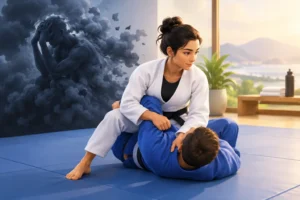
Brazilian Jiu-Jitsu spends more time on the ground. Children learn positions such as guard, mount, side control, and back control, then practice escapes, reversals, control, and age-appropriate submissions. BJJ gives kids repeated opportunities to solve problems from difficult positions. Rather than seeing a bad spot as failure, they learn to stay calm, make a decision, and work their way out.
That difference matters, but it should not be treated as a rigid rule. A well-rounded youth BJJ program should teach takedown awareness and safe falling. A strong youth Judo program should teach valuable ground control. The best academies help kids become capable grapplers, not students who only understand one moment of a match.
When BJJ May Be the Better Fit
BJJ is often an excellent choice for children who enjoy puzzles, detail, and steady progress. A smaller or less explosive child can quickly see that leverage, positioning, and patience matter. That can be powerful for a child who has felt overlooked in sports where size and speed dominate.
The ground-based nature of BJJ also gives coaches time to teach composure. During controlled live practice, children encounter resistance without the chaos of a striking sport. They learn that getting stuck under a partner is not a reason to panic. It is a signal to use the escape they have practiced. Over time, this can build real confidence that carries into school, friendships, and new challenges.
For parents thinking about self-defense, BJJ offers useful lessons in distance, control, and getting back to the feet. Most youth self-defense situations do not need a child to win a fight. They need a child to recognize trouble, create space, protect themselves, and get to a trusted adult. BJJ reinforces calm decision-making and body control while emphasizing that martial arts skills should be used responsibly.
BJJ can also be a good long-term fit for kids who want a clear technical path. They can improve in visible ways: holding position longer, escaping more efficiently, using better posture, or helping newer teammates understand a drill. Progress is earned through consistency, not just through winning rounds.
When Judo May Be the Better Fit
Judo may appeal to a child who loves movement, fast reactions, and the excitement of learning a well-timed throw. It develops balance, coordination, grip strength, and spatial awareness. Kids learn how to move confidently with another person rather than freezing when someone grabs or bumps into them.
One of Judo’s greatest gifts is learning to fall correctly. Breakfalls are taught from the beginning and practiced regularly. While no sport can prevent every injury, learning how to land with awareness can help children build better body control during martial arts, playground play, and other athletic activities.
Judo is also a strong choice for children interested in wrestling, competitive grappling, or sports that reward explosive movement. The ability to establish grips, break balance, and finish a takedown is valuable across many disciplines. A child who thrives on action may find the standing exchanges in Judo especially engaging.
There are trade-offs. Throws require close attention to mat space, partner matching, and coaching standards. Parents should look for a program that teaches breakfalls carefully, scales techniques to the child’s age and ability, and never treats hard landings as proof of toughness. Good Judo coaching builds courage without being reckless.
Safety Is About Coaching, Not Just the Style
Parents sometimes assume BJJ is automatically safer because much of the work happens on the ground, or that Judo is too rough because it includes throws. The reality is more nuanced. Both can be safe youth sports when taught in a structured environment.
Look for instructors who group children thoughtfully, explain why a drill matters, and set clear expectations for respect. Young students should learn how to tap, how to release immediately, how to practice with control, and how to be a good training partner. In Judo, they should also receive patient instruction in breakfalls before being asked to throw with speed or force.
A quality academy does not rely on intimidation or let stronger children dominate smaller classmates. Coaches should supervise live training, correct unsafe behavior quickly, and make beginners feel welcome. The goal is not to make children fearful of losing. It is to teach them how to learn safely when something does not go their way.
Consider Your Child’s Temperament and Goals
Your child does not need to arrive with a firm preference. In fact, many children cannot know which style they enjoy until they try a class. Still, a few patterns can help you decide where to start.
A child who likes close-range problem-solving, enjoys technical games, or needs help staying calm under pressure may connect quickly with BJJ. A child who loves tumbling, fast movement, and athletic challenges may be drawn to Judo. A child who wants confidence after bullying concerns may benefit from either program, provided the academy teaches boundary-setting, awareness, and de-escalation alongside physical skills.
Age can influence the decision as well. Younger children often need classes that use simple games, clear routines, and frequent encouragement. Older kids may enjoy more technical instruction, structured sparring, and competition opportunities. In either case, the coach’s ability to communicate with children matters more than an impressive list of techniques.
It also helps to be honest about logistics. The best program is one your family can attend consistently. One class per week at a supportive academy can create more progress than an ambitious schedule that becomes stressful after a month. Look for a culture where your child is known by name, encouraged to improve, and excited to return.
Why Cross-Training Can Be a Smart Answer
For many families, the answer to BJJ versus Judo is not permanent. Kids can begin with the class that feels most inviting, then add the other discipline as their confidence and interest grow. BJJ students benefit from stronger takedowns and breakfalls. Judo students benefit from deeper ground control and escape skills.
Training in both also helps children understand that martial arts are not about collecting moves. They are about adaptation. Sometimes the right answer is to stay balanced and avoid a takedown. Sometimes it is to recover safely from the ground. Sometimes it is to disengage completely and get help.
At Imperial BJJ Lakewood, youth training is built around that larger goal: helping children develop skill, discipline, resilience, and respect in a team environment. A child does not need prior experience or natural athletic ability to begin. They need patient instruction, consistent practice, and a community that expects their best while supporting their growth.
The right first class should leave your child tired, proud, and eager to tell you what they learned. Start there, watch how they respond to the coaching and community, and give them enough time to discover the confidence that comes from showing up again.




No comment yet, add your voice below!