
Walking through the door is often harder than the first class itself. A good guide to martial arts free trials should make that step feel clear, not intimidating. Whether you want practical self-defense, a stronger fitness routine, a competitive outlet, or a positive program for your child, a trial gives you the chance to experience the academy before making a commitment.
The goal is not to prove that you are already tough, flexible, or experienced. The goal is to find a place where you can train consistently, learn with confidence, and become part of a community that expects your best while supporting your progress.
What a Martial Arts Free Trial Should Tell You
A free trial is more than a complimentary workout. It is your opportunity to see how an academy teaches, how students treat one another, and whether the program fits your life. The right school will make beginners feel welcome without lowering its standards. You should see structure in the class, attentive coaching, and training partners who understand that everyone starts somewhere.
Pay attention to the atmosphere before class begins. Are instructors present and engaged? Do advanced students help newer members without acting superior? Is the training space clean, organized, and built around safety? Those details reveal a great deal about the culture you will be joining.
You should also notice whether instruction has a purpose. Brazilian Jiu-Jitsu, Muay Thai, kickboxing, wrestling, and judo each have different demands, but quality coaching gives students a path forward. A beginner should understand what they are practicing, why it works, and how to train it responsibly.
Choose a Trial Based on Your Real Goal
There is no single best martial art for every person. The strongest choice depends on what you want from training and what will keep you showing up after the excitement of the first week wears off.
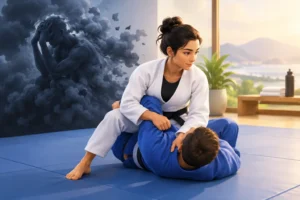
If your main focus is confidence, control, and close-range self-defense, Brazilian Jiu-Jitsu can be an excellent fit. It teaches leverage, positioning, escapes, and submissions, allowing smaller practitioners to develop practical skills against larger opponents. It also rewards patience and problem-solving as much as athletic ability.
If you want a high-energy workout with striking skills, fitness kickboxing or Muay Thai may be the better starting point. These classes build conditioning, coordination, footwork, and stress relief. Muay Thai adds a deeper striking system that includes punches, kicks, knees, elbows, and clinch work, while fitness-focused kickboxing may be especially appealing if your first priority is getting active.
For people interested in takedowns, balance, and body control, wrestling and judo training bring another dimension. Cross-training can be valuable, but you do not need to decide your entire martial arts future before your first class. Start with the program that addresses your immediate goal, then learn what else the academy offers as you gain experience.
How to Prepare for Your First Class
You do not need special skills or an expensive collection of gear to begin. Most academies will tell you what to wear for a trial, and many can provide loaner equipment for your first sessions. In general, arrive in clean athletic clothing, bring water, and wear footwear that is easy to remove if you are attending a grappling class.
Get to the academy a little early. This gives you time to complete any waiver, meet the instructor, and ask practical questions without feeling rushed. Let the coach know if you have an injury, physical limitation, or concern about intensity. Good instructors can offer modifications and pair you appropriately while you build confidence.
Come prepared to learn, not to win. New students sometimes worry about sparring or rolling on day one. That concern is understandable. A responsible academy introduces resistance in a controlled way and does not throw beginners into situations they are not ready for. You may work with a partner, drill a technique, hit pads, or complete conditioning exercises, but the class should be scaled to your experience.
A Guide to Martial Arts Free Trials: Questions Worth Asking
The questions you ask during a trial can help you look beyond a single fun class. First, ask how the beginner curriculum is structured. A program with clear fundamentals is easier to follow and gives you a reliable foundation before you move into more advanced training.
Ask who teaches the classes and how instructors develop their knowledge. Credentials matter, especially in technical disciplines such as Brazilian Jiu-Jitsu. An academy with a respected lineage and a consistent curriculum can provide confidence that students are learning proven systems rather than random techniques.
It is also reasonable to ask about class times, membership expectations, and what happens after the trial ends. The best schedule is not the most ambitious one on paper. It is the schedule you can maintain alongside work, school, family, and recovery. Training twice a week consistently will usually take you further than training five times one week and disappearing for a month.
Finally, ask how the academy handles safety and partner culture. Martial arts require contact, effort, and humility. They should never require reckless behavior. You want an environment where people train hard, tap early when needed, respect boundaries, and help one another improve.
Use the Full Trial, Not Just the First Impression
One class can show you whether the instruction is clear and the room feels welcoming. Several classes show you whether the program actually fits. If an academy offers a seven-day free trial, use it with purpose. Attend more than once if your schedule allows, ideally at different times or in more than one discipline.
The second and third class are often where the initial nerves start to fade. You may remember a position you learned, recognize another student, or notice that your body is already moving with more intention. That is when you can better judge whether you enjoy the work itself, not only the novelty of trying something new.
At Imperial BJJ Lakewood, a seven-day trial is designed to give prospective students room to experience structured training rather than make a decision based on a single visit. For Denver-area adults and families, that time can be especially valuable when comparing programs, schedules, and coaching styles.
Do not judge a class only by how exhausted you feel afterward. A hard workout has value, but quality martial arts instruction should also leave you with a new skill, a clearer understanding, or a specific area to improve. Progress comes from focused repetition, not from being pushed to the limit every session.
What Parents Should Look for in a Youth Trial
For children, the right martial arts program should feel challenging without becoming overwhelming. Parents should look for instructors who can hold attention, set firm expectations, and communicate with encouragement. The class should teach more than techniques. It should reinforce listening, respect, resilience, and how to respond calmly when things do not go as planned.
A youth trial is also a chance to see whether your child feels safe enough to participate. Some children jump into a new activity immediately; others need time to observe and warm up. Both reactions are normal. A skilled instructor knows how to guide different personalities without embarrassing a child or forcing participation before they are ready.
Ask how students are grouped by age and experience, how the academy addresses bullying, and what progression looks like over time. The strongest youth programs build confidence through earned improvement. A child should leave class feeling proud of the effort they made, even when a new skill was difficult.
Let Consistency Be the Deciding Factor
The best trial experience is not the one that makes the biggest promise. It is the one that makes you want to return. Look for knowledgeable coaching, a disciplined training environment, and people who will challenge you with respect.
Your first class does not have to be perfect. It only has to be the beginning of a habit that makes you stronger, more capable, and more connected each week.




No comment yet, add your voice below!