
A clean sweep or submission often starts before anyone hits the ground. The athlete who wins the grip exchange, breaks posture, and controls the direction of movement usually gets to dictate the next phase. That is how judo improves BJJ control: it gives Brazilian Jiu-Jitsu practitioners a sharper understanding of balance, connection, and pressure from the standing position through every scramble.
Judo does not replace BJJ. It fills in important details that many grapplers overlook when most of their training begins from knees, seated guard, or a neutral ground position. For beginners, that means feeling more composed when a round starts on the feet. For experienced students and competitors, it can mean turning a close exchange into a reliable takedown, a better pass, or a position an opponent cannot easily escape.
How Judo Improves BJJ Control From the First Grip
Control is not just holding someone down. It is the ability to influence where their weight goes, where their hands need to post, and which options are available to them. Judo develops that skill through constant attention to grips, posture, and kuzushi – the off-balancing action that makes a technique work.
In BJJ, a strong collar-and-sleeve connection can do much more than set up a throw. It can stop an opponent from standing out of open guard, keep their posture broken during a sweep attempt, and make their passing pressure less effective. The same idea applies to overhooks, underhooks, wrist control, and head position in no-gi training. The grip changes, but the purpose stays the same: create a connection, move the opponent’s balance, then advance with intention.
A common mistake is trying to control an opponent through strength alone. Judo teaches a more efficient answer. Instead of pulling harder, move their body at an angle where they are already weak. Instead of trying to force a takedown while they are planted and balanced, create a reaction first. That habit carries directly into guard passing, half guard battles, and front-headlock exchanges.
Better balance makes every position harder to escape
Good BJJ control depends on your own balance as much as your opponent’s. If your weight is too far forward during a pass, you can be swept. If your hips are too high in side control, you give space for a frame and hip escape. If you stand tall without a stable base while working grips, a simple foot sweep can put you on the mat.
Judo training makes athletes more aware of their base. You learn to keep your feet under you, adjust while being pulled or pushed, and recover when an opponent creates movement. Those skills are especially valuable in the messy moments between positions, when neither person has a settled guard, mount, or side control.
Think about a standing guard pass. A BJJ athlete may know the passing sequence but still struggle if their feet are narrow, their posture is upright, or they allow their opponent to pull them forward. Judo helps correct those problems by teaching posture under tension. Your feet, hips, hands, and head begin working together instead of acting independently.
Judo Builds Stronger Takedown-to-Control Transitions
The value of a takedown is not only getting points or putting an opponent on the floor. The real question is what happens immediately after the landing.
Judo teaches athletes to stay connected through the throw. Rather than launching an opponent away and then resetting, a controlled throw can place you in a position to establish top pressure right away. Depending on the technique and the ruleset, that could mean settling into side control, controlling a turtle position, entering a front headlock, or forcing a guard where you already have posture and grips.
This is a major difference between merely knowing a takedown and using one effectively for BJJ. A fast double-leg may score, but if you land with your head down and arms extended, you may end up in a guillotine or closed guard. A judo-informed entry emphasizes posture, connection, and balance throughout the finish. The goal is not just to complete the technique. It is to arrive in a position where your opponent must immediately defend.
Foot sweeps are a good example. They may not always create a dramatic throw, but they often force a hand to the mat, a rushed step, or a reaction that opens a body lock, single leg, or guard pull with favorable grips. In BJJ, those smaller off-balances can be as useful as a high-amplitude takedown because they create controlled entries into your best game.
Pressure is more effective when it follows movement
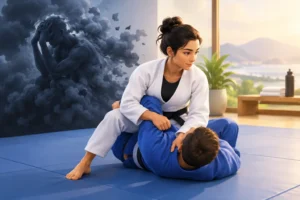
The same judo principle that makes a throw work can make top pressure more difficult to escape. When an opponent is trying to turn, bridge, or frame, their movement creates an opportunity to redirect their weight. Instead of meeting every escape with static force, learn to follow the direction of the escape and settle your weight where their structure is weakest.
For example, an opponent escaping side control may push into you to create space. If you recognize that pressure, you can redirect it into a transition toward mount, knee-on-belly, or north-south rather than simply squeezing harder. Judo develops sensitivity to these shifts because every grip fight and throw entry requires you to feel how someone is moving.
That sensitivity matters for smaller athletes, older students, and anyone who wants their technique to hold up against a stronger training partner. Strength helps, but timing and alignment make control sustainable over a long round.
Grip Fighting Adds Purpose to Your BJJ Entries
Many BJJ students know that grips matter, yet they approach grip fighting as a brief obstacle before attempting a takedown or guard pull. Judo treats the grip exchange as a technical battle in its own right. A dominant grip can limit an opponent’s posture, shut down their favorite attack, and create a clear path to your next movement.
In the gi, collar and sleeve grips teach disciplined hand placement. You learn not to reach carelessly, leave an elbow exposed, or accept a grip that gives your opponent control of your head and shoulders. That awareness helps with standing exchanges and guard work alike. A well-placed sleeve grip can prevent a post, slow a pass, and create the angle needed for a sweep.
In no-gi, the lesson becomes hand fighting. Inside position, wrist control, underhooks, collar ties, and body locks serve a similar purpose. You are not collecting grips for their own sake. You are using them to control posture and create reactions. The athlete who understands this often looks calmer in a scramble because they know which connection matters most.
There is a trade-off. Heavy gi-focused judo training does not automatically translate to every no-gi scenario, and competition rules shape how athletes stand and attack. BJJ practitioners should adapt the principles rather than copy every technique exactly. The transferable pieces are balance, timing, posture, hand fighting, and the ability to connect a takedown attempt to a dominant ground position.
Safer Training Creates More Confident Grapplers
Judo also teaches falling mechanics, often called breakfalls. Learning to fall safely builds confidence during takedown practice and reduces the hesitation that causes awkward injuries. A student who panics on the way down may post an arm, twist unpredictably, or resist at the wrong moment. A student who knows how to land can train with better awareness and return to their feet more calmly.
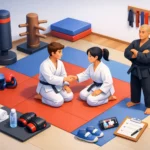
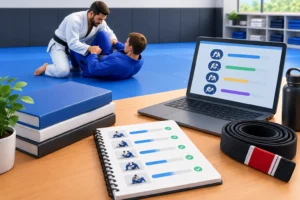
That does not mean every BJJ athlete needs to become a judo competitor. It means they should respect the standing phase enough to develop it progressively. Start with posture, movement, grips, breakfalls, and simple off-balancing drills. Add high-percentage trips, foot sweeps, body locks, and throws under qualified coaching. As confidence grows, the standing portion of a round becomes less chaotic and more technical.
For families, this approach is especially valuable. Young students gain coordination, body awareness, discipline, and respect for training partners. They learn that control is not about overpowering someone. It is about staying composed, using sound technique, and protecting both themselves and the people they train with.
At Imperial BJJ Lakewood, cross-training judo and wrestling alongside Brazilian Jiu-Jitsu gives students a practical way to develop those skills under one roof. Whether your goal is confidence, fitness, self-defense, or competition, the best place to begin is with controlled practice and a willingness to learn the details before chasing the highlight-reel throw.
The next time you train, pay attention to the moment before the sweep, pass, or takedown. Improve the grip, shift the balance, and stay connected as your partner moves. Those small decisions are where lasting control is built.


No comment yet, add your voice below!