
You do not need to be fit, flexible, tough, or experienced to begin. You only need enough curiosity to walk through the door. This guide to your first martial arts trial will help you arrive prepared, understand what happens in class, and get the most from those first sessions without putting pressure on yourself to perform.
For many people, the hardest part of training is not the workout. It is the moment before it starts: wondering whether everyone will be advanced, whether you will know what to do, or whether you will feel out of place. A well-run academy is built to remove that uncertainty. Your trial is not an audition. It is a chance to see whether the coaching, classes, and community are right for you.
What Your First Martial Arts Trial Is Really For
A trial class gives you a real look at training, not just a quick tour. You should be able to meet coaches, experience the pace of a beginner-friendly class, and see how students treat one another. That matters more than whether you remember every technique on day one.
The right program depends on what you want from martial arts. Brazilian Jiu-Jitsu can be a strong fit if you want practical grappling, problem-solving, and close-range self-defense. Muay Thai and kickboxing are excellent for conditioning, striking skill, stress relief, and confidence. Judo and wrestling build balance, body control, takedowns, and resilience. For children, martial arts should offer more than activity. It should teach listening, respectful behavior, emotional control, and the confidence to handle challenges.
You do not have to choose a lifelong path before your first class. If you are interested in more than one discipline, ask how the academy structures cross-training and whether beginners can explore different programs. Training under one roof can make it easier to build a well-rounded foundation while finding the style you enjoy most.
How to Prepare for Your First Martial Arts Trial
Preparation should be simple. Arrive 10 to 15 minutes early so you can check in, meet the instructor, and get oriented without rushing. Let the coach know if you have injuries, physical limitations, past training experience, or concerns about contact. Good instructors would rather adjust a drill early than have you push through discomfort in silence.
Wear clean, comfortable athletic clothing that allows you to move. For a striking class, a T-shirt or athletic top with shorts or workout pants is usually appropriate. Avoid clothing with zippers, buttons, or anything that could scratch a training partner. For Brazilian Jiu-Jitsu, the academy may provide a loaner uniform for your trial or tell you what to wear before you arrive.
Bring water and a small towel if you tend to sweat. Remove jewelry, keep fingernails and toenails trimmed, and avoid heavy fragrances. These are small details, but martial arts is close-contact training. Cleanliness and consideration are part of respect for your teammates.
Eat something light a couple of hours beforehand if possible. Showing up dehydrated or after a very heavy meal can make a first workout harder than it needs to be. If your schedule only allows you to come straight from work, that is fine. Just tell yourself the goal is to start, not to show up under perfect conditions.
What You Do Not Need to Buy Yet
Do not feel pressured to purchase gloves, a gi, shin guards, or other equipment before you know which program fits. Most academies can explain what is required after your trial and may have gear available for new students. Investing in the right equipment is worthwhile once you are training consistently. Buying everything first is not necessary.
What Happens in a Beginner Martial Arts Class
Every school has its own structure, but most classes follow a familiar rhythm. You will begin with a warm-up designed to prepare your joints, movement, and conditioning. Next, the instructor will demonstrate one or more techniques, breaking them into clear steps. Then you will practice with a partner, often at a controlled pace, while the coach circulates to offer corrections.
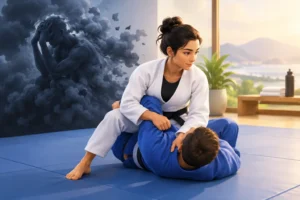
In Brazilian Jiu-Jitsu, you might learn how to move safely on the ground, escape a basic position, or apply a controlled submission. In Muay Thai or fitness kickboxing, you may work on stance, footwork, punches, kicks, and pad drills. In judo or wrestling, you may practice balance, grips, breakfalls, and the mechanics of a takedown.
Some classes include positional sparring, rolling, or controlled live drills. This is where beginners often worry most, but the appropriate intensity depends on your experience and comfort level. You should never feel forced to go hard. A responsible academy teaches control before intensity and pairs new students with people who can help them learn safely.
Expect to feel challenged. You may get winded faster than you anticipated, forget a step, or feel awkward coordinating your hands and feet. That is normal. Martial arts asks your body and brain to learn new patterns at the same time. Progress comes from repetition, not from getting everything right immediately.
Questions Worth Asking During Your Trial
A trial is also your opportunity to evaluate the academy. Notice how the instructor explains techniques. Are the details clear? Do they correct students with patience and purpose? Is safety treated as part of the lesson, not an afterthought?
Ask how beginners progress through the curriculum and how often you should train to see steady improvement. For most adults, two or three classes per week is a realistic starting point. One class a week can still be valuable, especially for a busy schedule, but skill development and conditioning will build more slowly. The best schedule is one you can maintain.
Parents should ask how youth classes are grouped by age and maturity, how coaches handle behavior, and how the program teaches confidence without encouraging aggression. A strong kids program has structure. Children should leave feeling supported and capable, while also understanding that respect and self-control come first.
It is also fair to ask about the culture. Do students greet newcomers? Do experienced members work safely with beginners? Is there room for both people who want fitness and people who want competition? A serious academy can have high standards without making new people feel like outsiders.
How to Get Past First-Class Nerves
The people who look comfortable on the mats were beginners once. Most remember exactly what it felt like to tie on a borrowed uniform, put on gloves for the first time, or worry about making a mistake in front of others. They improved by returning.
Give yourself one job for the first class: listen carefully and keep moving. Do not compare your first hour to someone else’s fifth year. If you do not understand a drill, ask. If you need a break, take one. If a technique feels too fast, say so. Confidence in martial arts is not pretending you have no limits. It is learning how to work through challenges with discipline and awareness.
At Imperial BJJ Lakewood, that balance of high-level instruction and support is central to the training environment. Technical standards matter, but so does having teammates who want to see you improve.
After the Trial: Deciding Whether to Continue
Do not judge your experience solely by how exhausted you are. A hard workout can feel satisfying, but a good martial arts home offers more than sweat. Consider whether you felt safe, whether the instruction made sense, and whether you could picture yourself returning after a difficult day.
You may leave sore in places you did not know could be sore. That is common when you begin a new movement practice. Drink water, get good sleep, and give your body time to adapt. Mild muscle soreness is expected; sharp pain or joint pain is not something to ignore. Communicate with your coach and adjust as needed.
The biggest difference between people who try martial arts and people who are changed by it is rarely natural athletic ability. It is consistency. Take the first class seriously, but do not demand a verdict on your potential from one session. Show up willing to learn, find a community that raises your standards while respecting your starting point, and let the confidence come one class at a time.




No comment yet, add your voice below!