
Walking into your first Denver BJJ class can feel like stepping into a room where everyone already knows the language. People are tying belts, drilling positions, and moving with a level of comfort that may seem far away on day one. The right academy changes that quickly. It gives you a clear starting point, partners who want to see you improve, and coaching that turns uncertainty into progress.
Brazilian Jiu-Jitsu is not reserved for elite athletes or people who grew up playing contact sports. It is a practical, technical martial art built around leverage, timing, position, and composure. You can begin with no experience, build at your own pace, and still train in an environment that challenges you to become more capable every week.
What a Strong Denver BJJ Academy Should Offer
The best academy for you is not always the closest one or the one with the loudest marketing. Convenience matters because consistency matters, but the quality of the instruction and culture will shape whether you stay long enough to see real results.
Start with coaching. A good BJJ program has a structured curriculum, especially for beginners. You should not be left trying to copy advanced students without understanding why a position works. Early classes should teach fundamental movement, safe falling, positional awareness, escapes, control, and the basic concepts that connect each technique.
Lineage and coaching standards matter as well. Brazilian Jiu-Jitsu has a deep tradition of technical development, and a school with a respected affiliation can offer confidence that its instruction is connected to a proven system. At Imperial BJJ Lakewood, students train under the Demian Maia Jiu Jitsu Brasileiro affiliation, bringing a technical, pressure-based approach shaped by one of the sport’s most respected practitioners.
A strong academy also protects its training culture. Hard rounds and healthy competition have a place, particularly for athletes who want to compete. But beginners need controlled training, clear expectations, and experienced teammates who understand that everyone has a different starting point. Respect is not separate from serious training. It is what makes serious training sustainable.
Your First Denver BJJ Class: What Actually Happens
Most first classes begin with a warm-up designed around movements you will use on the mat. Expect to learn how to move your hips, post safely, bridge, shrimp, and stand with balance. These drills can feel unfamiliar at first, but they become useful quickly because they support almost every position in Jiu-Jitsu.
From there, an instructor typically demonstrates a technique in manageable steps. You may work on escaping from the bottom, controlling an opponent from the top, passing the guard, or defending a simple submission. The objective is not to memorize a hundred moves. It is to understand a few ideas well enough to apply them with a partner.
Many newcomers worry most about sparring, often called rolling. Whether you roll in your first class depends on the academy and the program. Some beginner classes introduce positional rounds right away, while others focus on drilling until students have more context. Neither approach is automatically better. What matters is that the coach explains the purpose, pairs students responsibly, and makes safety the priority.
You do not need to get in shape before you begin. Training is how you build the conditioning, mobility, coordination, and confidence that many people think they need in advance. Come prepared to learn, wear comfortable athletic clothing if a uniform is not required, trim your nails, and leave your ego outside the door.
Choose a Program That Matches Your Goals
People search for BJJ for different reasons, and the right program should meet you where you are. If your main goal is fitness, BJJ gives you a demanding workout without the monotony of counting reps on a machine. Every class asks you to solve physical problems, stay present, and work with a partner. The result is conditioning with a purpose.
If self-defense is your priority, look for teaching that emphasizes control, positional awareness, and the ability to stay calm under pressure. Jiu-Jitsu is especially valuable because it teaches you how to manage close-range situations where strength alone is not enough. Still, self-defense is not one technique or one perfect response. It is built through regular practice, sound judgment, and confidence under stress.
For aspiring competitors, ask about competition classes, coaching support, and the level of training partners available. Competition can accelerate your development by giving you a specific goal and exposing gaps in your game. It also requires time, recovery, and patience. Not every student needs to compete to train seriously, and not every serious academy treats medals as the only measure of progress.
Families should look beyond the word “discipline” in a youth program. Children need instructors who can teach attention, respect, movement, and resilience in ways that are age-appropriate. A quality kids program helps young students practice boundaries, handle frustration, and grow more confident around peers. For many parents, the strongest sign of a good program is simple: their child is challenged, supported, and eager to come back.
Why Cross-Training Can Make You Better
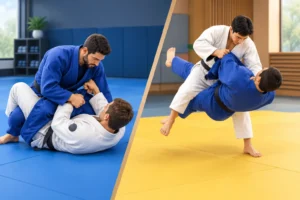
BJJ is a complete pursuit on its own, but training alongside other martial arts can make your development more well-rounded. Wrestling and Judo improve takedowns, balance, gripping, and the ability to control where an encounter takes place. Muay Thai and kickboxing build striking awareness, distance management, conditioning, and confidence on your feet.
That does not mean every beginner should train every discipline immediately. Starting with too many classes can make your schedule harder to maintain and leave you sore enough to quit. Begin with the program that best matches your primary goal. Once your routine is established, cross-training can add useful skills without pulling your focus away from the fundamentals.
For adults with busy work and family schedules, a multi-discipline academy can also make training more practical. You can build a weekly plan that includes BJJ as your foundation and adds striking or takedown training when it serves your goals. The value is not collecting styles. It is becoming a more adaptable martial artist while staying part of one training community.
Questions Worth Asking Before You Join
A trial class tells you more than a website ever can. Notice whether the instructor learns your name, whether students train safely, and whether people treat newcomers like future teammates rather than obstacles. A welcoming academy should not lower its standards for beginners. It should give beginners a clear path to meet those standards.
Ask how the beginner curriculum is structured and what progress looks like in the first few months. Find out whether classes accommodate different experience levels, how sparring is introduced, and whether you can train consistently at times that fit your schedule. You can also ask about membership options, uniform requirements, and whether the academy offers a trial period so you can make an informed decision.
Pay attention to the atmosphere after class. Are students helping each other improve? Is the room focused without being hostile? Do coaches correct details with patience and authority? BJJ is demanding enough that you should not have to fight the culture of the room, too.
Progress Comes From Showing Up
Your first months of BJJ will include plenty of moments when you feel behind. You will forget techniques, get stuck underneath someone, and discover how much there is still to learn. That is normal. Progress in Jiu-Jitsu is rarely a straight line. One week you may finally understand an escape; the next week you may feel as if everyone is better than you.
Keep showing up. Train with intention, ask questions, and measure improvement against your past self rather than the most experienced person in the room. Over time, the small wins add up: calmer breathing, sharper movement, better decisions, stronger conditioning, and a confidence that carries beyond the mat.
The best Denver BJJ academy is the one where you can train consistently, learn from credible coaches, and become part of a community that expects your best while supporting your growth. Take the first class with an open mind. The person you become through regular practice is worth the first uncomfortable step.



No comment yet, add your voice below!