
A clean hip throw can end an exchange before it ever reaches the ground. A controlled guard pass can turn a bad position into a dominant one minutes later. That is the heart of BJJ versus Judo: both are demanding grappling arts, but they reward different ranges, rhythms, and decisions.
If you are choosing your first martial art, the question is not simply which one is better. It is which discipline matches your goals, your body, and the kind of challenge that will keep you coming back to train.
BJJ Versus Judo: The Core Difference
Brazilian Jiu-Jitsu and Judo share a family tree. Both developed from Japanese jujutsu traditions, both use throws, pins, chokes, and joint locks, and both teach students to rely on timing and technique rather than strength alone. Yet their modern training priorities are distinct.
Judo emphasizes the standing clinch. Students learn grips, balance-breaking, foot sweeps, trips, hip throws, and powerful takedowns designed to put an opponent on the mat decisively. In a traditional Judo match, a clean, forceful throw can end the contest immediately. Ground fighting exists, but it is usually fast-paced and limited by the referee if progress stalls.
BJJ spends far more time on the ground. Students learn how to escape pins, maintain control, pass the guard, take the back, and finish with chokes or joint locks. Takedowns matter in BJJ, especially for self-defense and competition, but the art is built around what happens after contact reaches the floor.
Think of Judo as an art that asks, “Can you put someone down?” BJJ asks, “Once you are both down, can you control the situation?” Both questions matter.
What Training Feels Like in Each Art
A Judo class often begins with breakfalls. Learning to fall safely is not a minor detail when training includes throws. Students drill entries, grips, movement, and repetitions of throws before practicing them against a resisting partner. The work can be explosive, athletic, and technical all at once.
A BJJ class often includes positional drills and live rounds called rolling. You may start beneath side control and work on escaping, or begin in guard and practice passing. The pace can be intense, but training is often more methodical than people expect. You learn to stay calm while pinned, identify small openings, and connect movements into a sequence.
Neither art is easy. Judo can be physically demanding because of repeated throwing, gripping, and impact. BJJ can be mentally exhausting because each round presents dozens of decision points. In both, a skilled partner will quickly show you where your posture, balance, or awareness needs work.
Throws, Takedowns, and Ground Control
The clearest technical difference is where each art places its deepest expertise.
Judo gives students a highly refined takedown system. A practiced Judoka understands how to disrupt balance before attempting a throw, how to use an opponent’s movement against them, and how to create power through leverage rather than muscling someone over. This makes Judo especially valuable for people who want confidence in the clinch or want to develop dynamic takedowns.
BJJ teaches takedowns too, but its strongest advantage is the depth of its ground game. A BJJ student becomes comfortable in positions that make many untrained people panic: being mounted, trapped underneath side control, caught in a headlock, or forced to fight from their back. The goal is not merely to survive. It is to improve position, control the opponent, and find a safe finish when appropriate.
For self-defense, this distinction matters. A hard throw on concrete can cause serious injury to anyone involved, so real-world awareness and restraint always come first. Still, Judo provides useful skills for staying upright and managing a clinch. BJJ provides useful skills if the encounter becomes entangled or goes to the ground. The strongest answer is often training both ranges with good judgment.
Which Is Better for Fitness?
Both Judo and BJJ build useful, full-body conditioning. You will develop grip strength, core stability, mobility, coordination, and cardiovascular endurance without staring at a treadmill timer.
Judo tends to involve more explosive movement. Throws require timing, lower-body drive, pulling strength, and the ability to recover quickly after each exchange. The repeated work of gripping and throwing can be demanding on the hands, shoulders, and hips.
BJJ develops a different kind of endurance. Rolling forces you to move efficiently under pressure. You learn that holding your breath and straining through every position drains your energy fast. Over time, students build body awareness, mobility, and practical strength while improving their ability to remain composed when tired.
The better workout is the one you will train consistently. If you love the speed and force of standing exchanges, Judo may keep you motivated. If you enjoy problem-solving, close-range control, and a deeper ground game, BJJ may become the habit that changes your fitness for good.
Competition Rules Change the Answer
When comparing BJJ versus Judo, it helps to separate the martial arts from their competition rules.
In Judo competition, athletes wear a gi, fight for dominant grips, and pursue a decisive throw. Ground exchanges are allowed, but officials typically stand athletes up when the action slows. This rewards aggression, balance, and the ability to create a clean scoring moment.
In BJJ competition, athletes can spend much longer fighting on the ground. Points are awarded for advancing to strong positions such as mount, back control, and passing the guard. Submission attempts are central, and a match may involve a slow tactical battle for grips, angles, and control.
That does not mean Judoka cannot grapple on the ground or that BJJ athletes cannot throw. Many high-level athletes cross-train successfully. It simply means each rule set shapes the habits students practice most often.
Is BJJ or Judo Better for Beginners?
A good school and a thoughtful coach matter more than the label on the door. Beginners need a safe culture, clear instruction, respectful training partners, and permission to learn at their own pace.
BJJ is often easier for adults to start because students can train hard without taking repeated high-amplitude falls. It is also approachable for people who worry that they are not naturally athletic. Technique, patience, and consistency matter greatly, and newer students can scale intensity as they develop confidence.
Judo can be an outstanding choice for beginners who want athletic movement and practical falling skills. However, the impact of throws may feel intimidating at first, particularly for adults returning to exercise after years away. A quality program will teach breakfalls progressively and never rush students into situations they are not ready to handle.
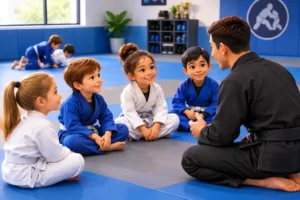
For kids, either art can support discipline, confidence, coordination, and respect. The right fit often comes down to the child’s personality. Some love the fast action of throws. Others thrive in the puzzle-like control and movement of BJJ.
Why Cross-Training Makes Sense
You do not have to treat this as a permanent either-or decision. A BJJ practitioner who adds Judo can become more comfortable initiating contact, fighting for grips, and taking an opponent down with control. A Judoka who adds BJJ can gain more confidence when a throw does not end the exchange and the fight continues on the mat.
Cross-training also teaches a valuable lesson: no single range tells the whole story. Standing distance, clinch work, takedowns, ground control, and the ability to disengage all have a place in practical martial arts training.
At Imperial BJJ Lakewood, students can develop their grappling through structured BJJ instruction while also exploring Judo and wrestling skills in a supportive training environment. That combination serves beginners building confidence and experienced athletes sharpening the gaps in their game.
Choose the Art You Will Practice Consistently
Choose Judo if the idea of throws, trips, balance, and dynamic standing grappling excites you. Choose BJJ if you want to build confidence on the ground, learn submissions and escapes, and solve technical problems under pressure.
Better yet, take the pressure off making a perfect decision before your first class. Train, ask questions, and pay attention to how you feel after a few sessions. The right martial art should challenge you, humble you, and make you want to return with a better attitude tomorrow.



No comment yet, add your voice below!