
The best bjj gyms do more than teach submissions. They give you a place to be challenged without being embarrassed, coached without being ignored, and welcomed without lowering the standard. That matters whether you are walking into your first martial arts class, returning after years away, or looking for a room where serious training has a clear purpose.
A good academy can improve your fitness, confidence, composure, and ability to solve problems under pressure. A poor fit can make training feel confusing, unsafe, or unnecessarily intimidating. Before you commit to a membership, look beyond the mats and ask what kind of learning environment you are actually joining.
What Great BJJ Gyms Have in Common
Brazilian Jiu-Jitsu is often called a gentle art, but it is not casual. You are learning to control distance, posture, balance, and another person’s movement while staying calm in difficult positions. Progress depends on consistent practice and quality instruction, not on being the strongest person in the room.
That is why coaching should be the first thing you evaluate. Look for instructors who can explain not only what to do, but why it works. A sound class has a clear structure: warm-up and movement, technical instruction, supervised drilling, and appropriately managed live training. Beginners should not be tossed into hard rounds with no guidance, while experienced students should have enough depth and resistance to keep developing.
Lineage and curriculum also deserve attention. A recognized BJJ affiliation is not a replacement for good coaching, but it can show that the academy follows a tested technical standard and stays connected to high-level instruction. For students who value detail, structure, and long-term development, that connection matters.
Culture is the other half of the equation. Strong academies have tough training, but they do not confuse toughness with recklessness. Teammates train hard while respecting taps, helping new students learn the basics, and leaving ego at the door. You should expect accountability. You should never feel pressured to prove yourself through unsafe behavior.
Visit BJJ Gyms Before You Decide
A trial class tells you more than a website or a social media highlight reel ever can. Arrive a few minutes early and watch how people interact. Notice whether the coach greets new faces, whether students help each other, and whether the room feels organized before class begins.
Pay close attention to how instruction is delivered. Are techniques demonstrated from multiple angles? Does the instructor correct details as people drill? Can a beginner ask a question without feeling like they are slowing everyone down? Clear teaching is especially important in BJJ because small adjustments in grips, body position, and timing can completely change whether a technique works.
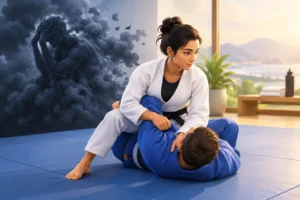
Then watch live sparring, often called rolling. The room does not need to be quiet or gentle, but it should be controlled. Experienced students should understand how to match intensity with newer training partners. Coaches should be present and willing to step in when someone is moving dangerously or ignoring a tap.
Cleanliness is practical, not cosmetic. Mats should be cleaned regularly, students should be expected to maintain clean uniforms and trimmed nails, and basic hygiene standards should be part of the academy culture. Skin infections can interrupt training quickly, so a professional gym treats mat care as part of taking care of its members.
Finally, ask yourself a simple question after class: could I see myself coming back two or three times a week? The most impressive facility is not automatically the right one if the schedule, instruction style, or atmosphere makes consistency unlikely.
Look for a Program That Matches Your Goal
Not everyone walks through the door for the same reason. The right program depends on what you want training to do in your life.
If your priority is fitness, you need class times you can realistically attend and training that keeps you engaged. BJJ is demanding, but it is also skill-based, which makes it more sustainable for many people than forcing themselves through the same workout alone. You will sweat, build strength, and improve conditioning while focusing on the next movement instead of staring at a clock.
If self-defense is your main concern, look for instruction that addresses positional control, escapes, awareness, and decision-making. Effective self-defense training is not about collecting flashy moves. It is about developing calm, reliable responses and understanding when disengagement is the best option.
If you want to compete, ask how the academy supports competitors. Competition-focused training should include technical development, focused rounds, coaching feedback, and teammates who are willing to prepare with intention. At the same time, a competitive room should not exclude hobbyists. The healthiest teams make space for people with different goals while holding everyone to the same standards of respect and effort.
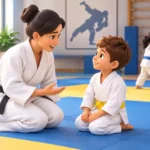
For families, the question is bigger than whether a child can learn a takedown or an armbar. A quality youth program teaches listening, emotional control, confidence, and how to respond to pressure without becoming aggressive. Age-appropriate classes should be organized, energetic, and closely supervised. Parents should be able to see that discipline is being taught with encouragement, not fear.
Why Cross-Training Can Make a Difference
BJJ is complete enough to be a lifelong practice on its own. Still, training at an academy that also offers wrestling, judo, Muay Thai, or kickboxing can add real value, depending on your goals.
Wrestling helps develop takedown pressure, balance, and the ability to control scrambles. Judo builds an understanding of grips, throws, and standing movement. Striking arts such as Muay Thai and fitness kickboxing improve distance management, coordination, conditioning, and confidence on the feet. For someone interested in well-rounded martial arts training, having those disciplines available under one roof can make a weekly schedule simpler and create a stronger connection between skills.
There is a trade-off. A gym that offers several programs still needs to teach each one well. Do not assume a long class menu equals quality. Ask whether each program has dedicated instruction, a logical curriculum, and a community of students who train consistently. Depth matters as much as variety.
At Imperial BJJ Lakewood, students can build their grappling foundation through an official Demian Maia Jiu Jitsu Brasileiro curriculum while also training across complementary combat sports. That combination supports beginners who want a clear starting point and experienced athletes who want more ways to sharpen their game.
Questions Worth Asking Before You Join
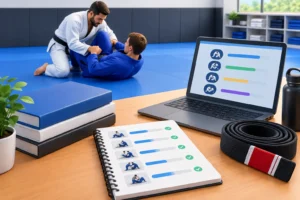
A good academy should answer direct questions clearly. You do not need to interrogate anyone, but you deserve to understand what you are signing up for. Ask how beginner classes work, whether there is a fundamentals path, and what a typical first month looks like. Ask about class schedules, membership terms, uniform requirements, and whether live training is required right away.
It is also reasonable to ask how the gym handles injuries and intensity. Every physical activity carries risk, and BJJ is no exception. Responsible coaching, progressive training, clean facilities, and respectful partners reduce that risk. Your own judgment matters too. Tap early, communicate with your partner, and do not train through pain simply because you feel pressure to keep up.
If you are an adult beginner, do not let your current conditioning decide whether you start. You will get tired. Everyone does. The goal of the first few weeks is not to look advanced. It is to learn the habits that make training safer and more productive: showing up, listening closely, breathing under pressure, and returning after a difficult class.
The Right Room Makes Consistency Possible
Most people do not quit BJJ because they cannot learn it. They quit because the gym was not a fit for their schedule, goals, or sense of belonging. Technique takes time to develop, and confidence arrives through repetition. A supportive room gives you enough challenge to grow and enough direction to keep showing up.
Choose a place where you respect the coaching, trust the training partners, and feel comfortable being a beginner. Then give yourself permission to learn slowly. The first class is not a test of whether you belong on the mat. It is the start of finding out who you can become through consistent work.



No comment yet, add your voice below!