
The hardest part of martial arts is rarely the first class. It is showing up three months later, when work gets busy, your child has a packed schedule, or the early excitement has faded. Learning how to stay consistent with martial arts means building a training practice that can survive real life – not relying on motivation to be perfect.
Consistency is where confidence, conditioning, technical skill, and self-defense ability are built. A single hard session can feel great, but steady training is what changes how you move, think, and respond under pressure. Whether you train Brazilian Jiu-Jitsu, Muay Thai, kickboxing, Judo, wrestling, or a combination of disciplines, the goal is the same: make training a dependable part of your week.
Start With a Schedule You Can Actually Keep
A common mistake is starting too aggressively. Someone feels motivated, signs up, and commits to training five or six days a week. For a few weeks, it may work. Then overtime, soreness, travel, or family responsibilities interrupt the plan, and missing one class starts to feel like failure.
A better starting point is two classes each week. Two sessions create enough repetition to improve while leaving room for the rest of your life. Once that rhythm feels normal, add a third class if your recovery and schedule allow it. Competitive athletes may train much more often, but a beginner who trains twice weekly for a year will make far more progress than someone who trains intensely for a month and disappears.
Put your classes on your calendar like appointments. Decide which days and times are your default training windows, then protect them. If your usual Tuesday class gets blocked by work, do not write off the entire week. Move that session to Wednesday or Saturday. The habit is not tied to one exact class time. The habit is returning to the mat.
Make the First Step Easier
On difficult days, the barrier is usually not the training itself. It is getting out the door. Reduce the number of decisions between finishing your day and arriving at class.
Pack your gi, no-gi gear, gloves, water, and towel the night before. Keep a spare set of essentials in your car if your schedule often changes. If you train after work, bring what you need with you rather than going home first. A comfortable couch has ended plenty of well-intended training plans.
Give yourself a simple rule: attend the warm-up, then reassess. You do not need to promise an exceptional performance every time. Sometimes you will feel sharp and energetic. Other times, you may drill carefully, move at a lower pace, and leave early if needed. Showing up for a lighter session is often the right decision. Pushing through a genuine injury is not.
Set Goals That Reach Beyond a Belt
Belts matter. They recognize time, skill, character, and the ability to apply what you have learned. But belt promotion can be a distant target, especially for adults with demanding jobs and families. If it is your only reason to train, progress can feel invisible between promotions.
Create smaller goals you can measure every month. You might aim to attend eight classes, learn the names of three positions, improve your hip escape, complete three rounds without sitting out, or feel comfortable introducing yourself to a new training partner. A parent may set a goal of helping their child attend consistently for a full school term rather than focusing only on the next stripe.
Technical goals are especially useful because they direct your attention. Instead of leaving class thinking, “I got submitted again,” you can ask, “Did I recognize the guard pass we practiced?” In martial arts, being able to notice a problem is often the first sign that you are improving.
Track Attendance, Not Just Results
Martial arts progress is uneven. One week, a sweep finally works against someone resisting. The next week, it may feel like everyone is ahead of you. That is normal. You are practicing skills against partners who are also learning, adapting, and becoming more capable.
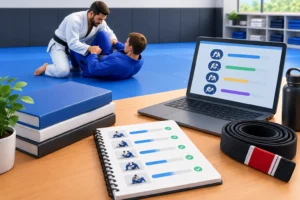
An attendance tracker gives you evidence that your work is adding up. Mark each class in a calendar, notebook, or phone app. Do not overcomplicate it. The point is to see the chain of effort, particularly during weeks when your confidence is low.
Track one or two details alongside attendance if it helps: the technique of the day, a question for your coach, or a small win. Over time, these notes become a record of growth that a bad sparring round cannot erase.
Train for Your Season of Life
There is no single ideal training schedule. A college student, a parent of young children, a shift worker, and a competitor preparing for an event will need different approaches. Consistency is personal.
During a demanding season, your minimum may be one class per week plus 10 minutes of mobility at home. That is still training. When life settles, you can increase your frequency. The important thing is avoiding the all-or-nothing mindset that turns a busy month into a long absence.
For parents, consistency often improves when martial arts is treated as a family commitment rather than another isolated errand. Youth programs give children structure, confidence, athletic development, and a constructive place to practice discipline. When a child sees a parent value regular training too, the lesson becomes stronger. Families do not need identical goals, but they can support the same standard of showing up.
Let Community Carry You When Motivation Drops
Motivation is useful, but it is temporary. Community is what often keeps people training after the novelty wears off. A good academy should be serious about standards while still being a place where beginners can ask questions, make mistakes, and return the next day.
Introduce yourself. Learn your training partners’ names. Tell someone you will see them at the next class. These small connections create accountability without pressure. You are no longer trying to convince yourself to exercise alone. You are part of a room of people working through the same difficult techniques and hard rounds.
At Imperial BJJ Lakewood, that shared effort can include grappling, striking, fitness training, and youth classes under one roof. Cross-training can keep your routine fresh, but it should support your primary goal rather than scatter your attention. A BJJ student may enjoy an occasional Muay Thai class for conditioning and confidence. Someone focused on striking may benefit from wrestling or Judo fundamentals. Choose a base, then add variety with purpose.
Ask Coaches for a Clear Next Step
New students sometimes assume they should wait until they are more experienced before asking questions. In reality, a clear question can prevent weeks of confusion. Tell your coach what feels difficult: remembering techniques, keeping up with conditioning, dealing with nerves before sparring, or fitting classes into your schedule.
A quality coach can help you focus on the next useful skill instead of trying to learn everything at once. In Brazilian Jiu-Jitsu, that might mean building reliable escapes before chasing advanced submissions. In Muay Thai or kickboxing, it may mean improving stance, guard, and footwork before worrying about complex combinations. Strong fundamentals make training more rewarding because you can recognize them working.
Expect Plateaus and Protect Your Body
Every martial artist reaches a plateau. You may attend class regularly but feel as though nothing is clicking. Often, your awareness has improved faster than your ability to execute. You now see mistakes you did not notice before. That can be frustrating, but it is also progress.
Stay patient and keep your training specific. Pick one position, one defensive reaction, or one combination to revisit repeatedly. Ask for feedback, drill with intention, and give the process time.
Consistency also requires recovery. Sleep, hydration, reasonable nutrition, and rest days are not separate from training. They are part of it. If you are injured, tell your coach and modify your work. Good training builds resilience; it should not demand that you ignore pain or turn every session into a test of toughness.
How to Stay Consistent With Martial Arts When You Miss a Week
Missing a week does not erase your progress. Vacations, illness, work deadlines, and family emergencies happen. The real risk is allowing a short interruption to become an excuse to wait for the “perfect” time to return.
Come back to the next available class. Do not try to punish yourself with extra sessions or compare your return to your best week of training. Expect to feel a little rusty, move carefully, and rebuild your rhythm. Your coaches and teammates have seen this before. The door is still open, and the mat is still there.
The most disciplined martial artists are not people who never lose momentum. They are people who know how to return to it. Choose your next class, pack your gear, and give yourself one more opportunity to show up.





No comment yet, add your voice below!