
The hardest part of anxiety is often not the big moment. It is the constant background noise: the racing thoughts before work, the tension in your shoulders, the urge to cancel plans, and the feeling that your mind is always one step ahead of you. BJJ for anxiety gives many people a place where that noise has less room to take over.
Brazilian Jiu-Jitsu is not a replacement for mental health care, medication, or counseling when those are needed. It is, however, a demanding and practical way to build a routine around movement, focus, problem-solving, and community. For many adults in Lakewood and the Denver metro area, stepping onto the mats becomes one of the most reliable parts of the week.
Why BJJ for Anxiety Feels Different Than a Typical Workout
A standard gym session can be helpful, but it also leaves plenty of mental space. You can run on a treadmill while replaying an awkward conversation, worrying about tomorrow, or checking the clock every two minutes. Brazilian Jiu-Jitsu asks for more of your attention.
When you are learning how to escape a side-control pin, maintain balance, or defend a simple grip, you need to be present. Your partner is moving. Your body position matters. Your breathing matters. The next step depends on what is happening now, not on what might happen later.
That level of engagement can create a meaningful break from rumination. You are not forcing your mind to be blank. You are giving it a real task. Over time, many students find that the mat becomes a place where they can practice staying composed when things feel uncomfortable.
There is a physical component, too. Training raises your heart rate, challenges your muscles, and gives your body a productive outlet for stress. After class, that nervous energy often feels less like a storm and more like fatigue you have earned.
The Lesson Is Not “Never Feel Anxious”
Good Jiu-Jitsu does not teach you to avoid pressure. It teaches you to recognize pressure, protect yourself, and work through it with patience.
That is one reason the sport can be so powerful for people dealing with anxiety. A new student may initially feel uneasy underneath a larger training partner or frustrated when a technique does not work. In a well-coached beginner class, those moments are controlled, respectful, and scaled to the student’s experience. You tap when you need to tap. You reset. You learn what happened. Then you try again.
That process builds a useful kind of confidence. Not the loud, performative kind that says nothing can go wrong. The quieter kind that says, “This is difficult, but I can slow down, breathe, and make a decision.”
Of course, training can also feel intense at first. If crowded rooms, close contact, or unfamiliar physical challenges trigger anxiety, it may take time to settle in. The right academy will not push a beginner into hard sparring on day one. Technical instruction, clear safety standards, and patient coaching make a major difference.
Structure Helps When Motivation Is Unreliable
Anxiety can make routines difficult. You may know that exercise, sleep, and social connection would help, but getting started can feel like another task on an already overloaded list.
A martial arts class creates structure outside your own head. There is a start time, a coach, a lesson plan, and training partners expecting to see you. You do not need to invent a workout or decide whether you are doing enough. You arrive, change clothes, and follow the process.
At first, the goal can be as simple as attending consistently. You do not need to become a competitor, lose a certain amount of weight, or be naturally athletic. Show up twice a week. Learn a few positions. Notice how you feel after class. Small commitments are easier to keep, and keeping them builds trust in yourself.
That consistency also gives you measurable progress. Maybe you remember the names of positions that felt confusing last month. Maybe you survive a round without holding your breath. Maybe you are no longer afraid to ask a training partner to go light. These are real wins, especially when anxiety has made you doubt your ability to improve.
Controlled Pressure Builds Better Breathing Habits
New students often discover that their biggest obstacle is not strength or flexibility. It is breathing.
When people feel trapped or overwhelmed, they tend to tense up and hold their breath. In Jiu-Jitsu, that burns energy quickly. Coaches repeatedly remind students to relax their shoulders, exhale, and avoid fighting every movement at full force. You learn that panic makes a hard position harder, while calm breathing gives you more options.
This does not mean you will suddenly become relaxed in every stressful situation off the mats. Real life is more complicated than a training round. But practicing a calmer response in a controlled setting can carry over. A difficult meeting, a traffic jam, or a tense conversation may still raise your stress level, yet you may recognize the physical signs sooner and return to your breath more deliberately.
The skill is not perfection. It is recovery.
Community Matters More Than Most Beginners Expect
Anxiety often makes people withdraw, even when they want connection. It can feel easier to stay home than to walk into a new room where everyone seems more experienced. That first step into a Jiu-Jitsu academy takes courage.
The good news is that martial arts communities are built around shared learning. Every experienced practitioner was once the person trying to tie a belt correctly, wondering where to stand, and mixing up left and right. Training partners remember that feeling.
Over time, familiar faces become part of the value of class. You work with people who encourage you after a rough round, help you remember a detail, and recognize the effort it took to show up. The relationships are earned through repetition, mutual respect, and training together – not forced small talk.
At Imperial BJJ Lakewood, beginner-friendly instruction is paired with serious technical standards through the Demian Maia Jiu Jitsu Brasileiro affiliation. That combination matters. Students deserve a welcoming environment, but they also deserve a curriculum with depth, purpose, and coaching they can trust.
How to Start BJJ When Anxiety Makes New Places Hard
Make the first visit smaller in your mind. You are not committing to a new identity or promising to become a fighter. You are simply coming in to observe, meet the coaches, and try one class.
Arrive a little early so you do not have to rush. Tell the instructor that you are new and that you are nervous. A professional coach will appreciate the honesty and can pair you with an appropriate partner. Wear comfortable athletic clothes if you do not yet have a gi, and focus on learning rather than performing.
Give yourself permission to take breaks. BJJ is challenging, particularly for beginners. If your heart rate spikes or you feel overwhelmed, step aside, get water, and reset. The goal is to leave class feeling capable, not defeated.
It also helps to avoid judging the experience by one day. The first class may feel awkward because every detail is unfamiliar. The second and third classes are often where the environment starts to make more sense. Anxiety thrives on uncertainty; familiarity reduces it.
When BJJ Should Be Part of a Bigger Support Plan
Brazilian Jiu-Jitsu can support mental well-being, but it should not carry the full weight of a serious mental health struggle. If anxiety is interfering with sleep, work, relationships, or your ability to function day to day, speaking with a licensed mental health professional is a strong and responsible step.
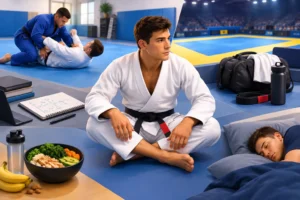
Training works best as one part of a larger foundation: professional support when appropriate, rest, nutrition, supportive relationships, and habits that help your nervous system recover. It is also worth being honest with yourself about intensity. Hard rounds can be energizing for one person and overstimulating for another. You can choose a slower pace, focus on technique, or take a recovery day when needed.
The mat is not a place to prove that you are unaffected by stress. It is a place to practice meeting stress with skill, patience, and support. Start with one class, let yourself be a beginner, and see what changes when you give your mind something real to work on.



No comment yet, add your voice below!