
You do not need to be a former athlete, naturally aggressive, or already in great shape to walk into a martial arts academy. Many adults begin after a long break from exercise, a stressful season at work, or the realization that their current gym routine is no longer giving them much back. The top reasons adults start martial arts are deeply personal, but they often lead to the same thing: a stronger body, a clearer mind, and a community that expects something meaningful from you.
Martial arts training is not a shortcut. Progress takes repetition, patience, and the humility to be a beginner. That is exactly why it can be so rewarding. Whether you are drawn to Brazilian Jiu-Jitsu, Muay Thai, kickboxing, wrestling, or judo, training gives adults a practical way to build discipline while enjoying the process.
The Top Reasons Adults Start Martial Arts
1. They want fitness with a purpose
A standard workout can make you sweat, but it does not always give you a reason to come back tomorrow. Martial arts does. Every class has a focus: learning a position, improving a combination, escaping a bad spot, or sharpening a skill you struggled with last week. Conditioning becomes the result of training toward something real.
Brazilian Jiu-Jitsu develops strength, mobility, grip endurance, body awareness, and cardiovascular conditioning through live problem-solving. Muay Thai and fitness kickboxing challenge coordination, footwork, power, and stamina. Judo and wrestling demand balance, explosiveness, and control. The best fit depends on your interests and your current physical condition, but all of these disciplines make training feel active rather than repetitive.
For adults who are returning to exercise, the goal does not need to be extreme. Consistent classes can improve energy, movement, and confidence long before someone feels like an advanced athlete. A good academy helps beginners build up at a smart pace instead of treating every first class like a test.
2. They want practical self-defense skills
Most people who begin martial arts never want to use their skills in a dangerous situation. That is the point. Real confidence comes from having better awareness, better composure, and a working understanding of how to protect yourself if avoiding conflict is no longer possible.
Quality self-defense training is not about pretending every situation has a perfect technique. It is about learning distance, posture, control, escapes, and how stress changes decision-making. Striking disciplines teach movement and defensive reactions. Grappling disciplines teach what to do when someone closes distance, grabs hold, or takes the encounter to the ground.
Training should also make people more responsible, not more reckless. The strongest martial artists understand that awareness, de-escalation, and leaving safely are almost always better than proving a point. The skill is valuable because it gives you options.
3. They are looking for confidence that is earned
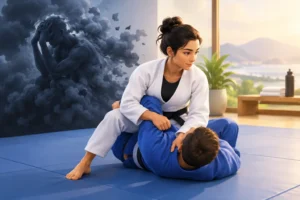
There is a difference between feeling hyped up and feeling capable. Martial arts develops the second kind. It is built through small proof points: attending when you are tired, learning a technique that initially felt impossible, staying calm while sparring, and realizing that you can handle more than you assumed.
That confidence often carries into life outside the academy. Adults report speaking up more comfortably, handling pressure with less panic, and approaching unfamiliar challenges with more patience. Martial arts does not remove hard days, but it teaches you how to keep working when things are hard.
The process can be uncomfortable at first. Being new means making mistakes in front of people who have more experience. In the right training environment, that is not embarrassing. It is normal. Coaches and training partners should push you while still respecting where you are starting.
4. They need a better way to manage stress
A demanding job, family responsibilities, screens, traffic, and constant notifications can leave people carrying tension all day. Martial arts class creates a clear boundary. For an hour, you have to be present.
You cannot effectively drill a takedown, defend a guard pass, or work a striking combination while mentally replaying every email in your inbox. Training requires attention, and that attention gives the mind a reset. The physical effort helps, too. You leave class tired, but often more settled than when you arrived.
This does not mean martial arts replaces professional mental health care when that support is needed. It can, however, be a powerful part of a healthy routine. Structured physical challenge, regular social contact, and measurable progress are useful anchors during stressful periods.
5. They want accountability without the gym pressure
Many adults know what they should do for their health. The harder question is how to keep doing it. A martial arts academy provides structure that a solo workout often cannot. Class times are set. Training partners notice when you have been gone. There is always another detail to improve.
That accountability should feel encouraging, not punishing. Some people want to train three to five times a week and compete. Others need two consistent classes around work and family. Both approaches can lead to progress. The right schedule is the one you can sustain.
A supportive academy also removes some of the uncertainty that makes traditional gyms intimidating. Instead of wandering between equipment and guessing what to do, you are coached through a lesson with a clear objective. You do not have to arrive knowing the language or the techniques. You just have to be willing to learn.
Martial Arts Gives Adults a Real Community
6. They want to belong somewhere that values effort
Adult friendships can be hard to build. Work is busy, people move, and casual plans often stay casual. Training brings together people who are willing to show up, work hard, and help each other improve. That creates connection quickly.
The community matters because martial arts is challenging. You will have tough rounds and frustrating days. You will also have teammates who remember your first class, celebrate a new belt or a successful competition, and encourage you when your motivation dips. The culture of an academy matters as much as the class schedule.
At Imperial BJJ Lakewood, students can train across grappling and striking disciplines under one roof, which gives adults room to find their preferred path while remaining part of one team. Some students fall in love with the technical depth of Jiu-Jitsu. Others prefer the pace of kickboxing or Muay Thai. Cross-training can be valuable, but it is not required to earn the benefits of consistent practice.
7. They want to learn a skill that keeps growing
Martial arts is different from a short-term fitness challenge because there is no quick finish line. A beginner can learn useful fundamentals quickly, but the deeper you train, the more there is to understand. Timing, leverage, strategy, conditioning, reactions, and mindset all develop over time.
That depth keeps training interesting. One person may enjoy the chess-like decisions of Brazilian Jiu-Jitsu. Another may be motivated by refining a clean punch-kick combination or becoming harder to take down. Competitive athletes can test themselves under pressure, while non-competitors can enjoy the discipline without ever stepping into a tournament or fight.
The trade-off is that progress is rarely linear. Some weeks you feel sharp. Other weeks, every round exposes a gap in your game. That is not failure. It is part of learning a demanding skill honestly.
8. They want to set an example for their family
Parents often start martial arts because they want more energy, confidence, or a constructive activity of their own. Many also recognize that children pay attention to what adults practice, not just what adults say.
When a parent commits to learning, shows respect to coaches and teammates, and keeps going after a difficult class, that example has weight. Training can become a family value centered on discipline, health, and resilience. It can also be practical family time when adults and children train in age-appropriate programs at the same academy.
You do not need a dramatic reason to begin. Curiosity is enough. Take a beginner-friendly class, ask questions, and give yourself time to see how training feels after the first nervous session. The right martial arts community will meet you where you are, then help you become someone stronger through the work you choose to do.




No comment yet, add your voice below!